I hate to break it to you, but you don't have the proper batting stance. Nope. Sorry. You just don't have it.
Why, you ask?
More...
Because as much as the baseball gurus, or your little league coach, or that overbearing neighborhood dad wants to tell you, there is no such thing as a "proper" batting stance.
There are weird batting stances. And there normal batting stances. And then there's yours, maybe somewhere in the middle. But if you're comfortable in the batter's box, then congratulations!
You... have a proper stance.
But, wait, it's not that simple...
No, of course it's not. You can't just stand there all knotted up and crazy and expect to be in a good hitting position when the ball is thrown.
You see, the crazier your stance is, the more movement you'll need to take to get back to a good, balanced, load position when the ball is being released. But as long as you can get there, you'll be fine.
Just look at these notoriously weird batting stances:

Weird Stance

Normal Load Position

Really Bizarre Stance

Totally Normal Load Position

Weird Stance

Normal Load Position

Weird Stance

Normal Load Position
As you can see, they all get to a good load position, regardless of where they start from. Even the strangest of these batting stances only lasts until the ball is being released by the pitcher, and then, everyone is more or less the same.
Timing is Everything...
You're timing is more or less the most crucial part of your swing, at least in terms of being able to make contact on a consistent basis. So, rather than focusing on how far apart your feet are in the box, or whether you have a "proper batting stance". Just focus on whether you can get into a rhythm with the opposing pitcher.
When I'm on deck, assuming that I'm loosened up, the only thing I'm trying to do is time the pitcher. Where do I need to be in relation to the pitcher's motion to put me in a successful pose to drive the ball.
My actual batting stance has very little to do with that.
So There Really is No Proper Batting Stance?
In my opinion, no.
But if you're a little league coach reading this, or a kid just starting out, there are a few basics to keep in mind when trying to find your comfort zone in the batter's box.
- Balance is your best friend. Aim to be in a balanced, athletic position as the pitcher is in his or her windup.
- Be aware of the location of your hands. In general, you don't want them too high or too low as the ball is approaching. The less that you have to move your hands up and down to get on plane with the ball, the better. I like mine to be just below ear level during my stance.
- Try to limit bat movement, but not to the point that you feel "frozen" in the box. It's good to stay loose, but there's no need to get all "Gary Sheffield" in your stance when you're just starting out.
So there you go. Don't sweat about your stance. Just be comfortable, confident, and be ready to attack the baseball when you see a fat pitch right down the middle. Good luck!
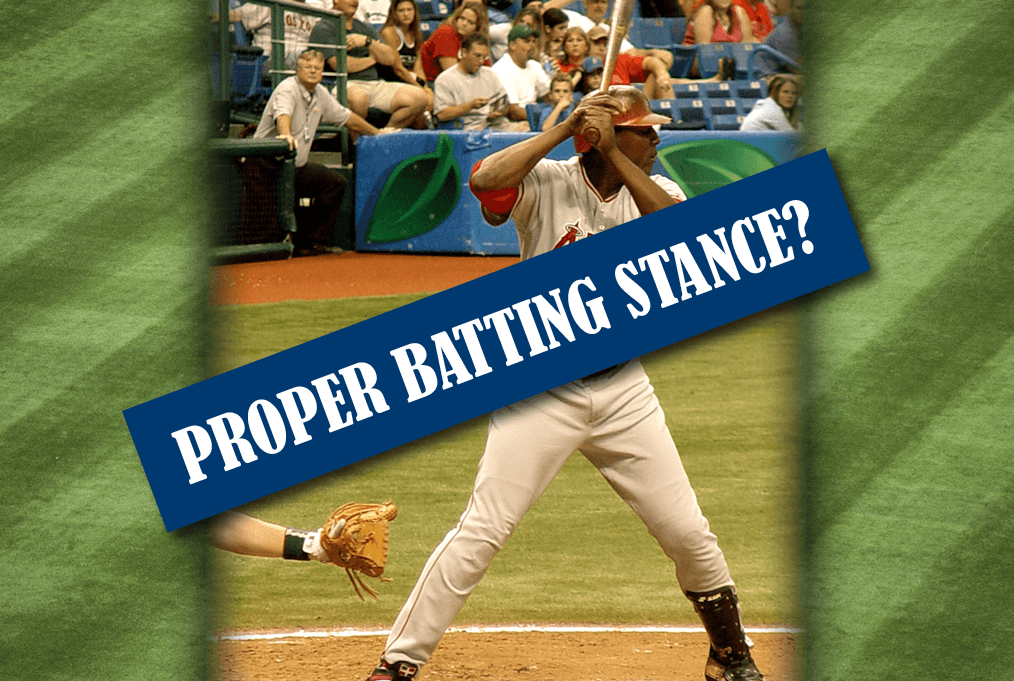
Proper Batting Stance – What is it and do you have one?
I hate to break it to you, but you don't have the proper batting stance. Nope. Sorry. You just don't have it.
Why, you ask?
More...
Because as much as the baseball gurus, or your little league coach, or that overbearing neighborhood dad wants to tell you, there is no such thing as a "proper" batting stance.
There are weird batting stances. And there normal batting stances. And then there's yours, maybe somewhere in the middle. But if you're comfortable in the batter's box, then congratulations!
You... have a proper stance.
But, wait, it's not that simple...
No, of course it's not. You can't just stand there all knotted up and crazy and expect to be in a good hitting position when the ball is thrown.
You see, the crazier your stance is, the more movement you'll need to take to get back to a good, balanced, load position when the ball is being released. But as long as you can get there, you'll be fine.
Just look at these notoriously weird batting stances:
Weird Stance
Normal Load Position
Really Bizarre Stance
Totally Normal Load Position
Weird Stance
Normal Load Position
Weird Stance
Normal Load Position
As you can see, they all get to a good load position, regardless of where they start from. Even the strangest of these batting stances only lasts until the ball is being released by the pitcher, and then, everyone is more or less the same.
Timing is Everything...
You're timing is more or less the most crucial part of your swing, at least in terms of being able to make contact on a consistent basis. So, rather than focusing on how far apart your feet are in the box, or whether you have a "proper batting stance". Just focus on whether you can get into a rhythm with the opposing pitcher.
When I'm on deck, assuming that I'm loosened up, the only thing I'm trying to do is time the pitcher. Where do I need to be in relation to the pitcher's motion to put me in a successful pose to drive the ball.
My actual batting stance has very little to do with that.
So There Really is No Proper Batting Stance?
In my opinion, no.
But if you're a little league coach reading this, or a kid just starting out, there are a few basics to keep in mind when trying to find your comfort zone in the batter's box.
- Balance is your best friend. Aim to be in a balanced, athletic position as the pitcher is in his or her windup.
- Be aware of the location of your hands. In general, you don't want them too high or too low as the ball is approaching. The less that you have to move your hands up and down to get on plane with the ball, the better. I like mine to be just below ear level during my stance.
- Try to limit bat movement, but not to the point that you feel "frozen" in the box. It's good to stay loose, but there's no need to get all "Gary Sheffield" in your stance when you're just starting out.
So there you go. Don't sweat about your stance. Just be comfortable, confident, and be ready to attack the baseball when you see a fat pitch right down the middle. Good luck!
editor's pick

latest video

news via inbox
Nulla turp dis cursus. Integer liberos euismod pretium faucibua
you might also like
- You must keep your hands inside the baseball. If you let your hands drift out (having a long swing), you're going to get jammed or you're going to pull the ball foul.
- You still have to be able to get your arms extended. This means that you need to hit the ball out in front of the plate.
- You need to clear your hips early. This is part of rotational hitting which is something that I will go into depth on in another article.
- First off, you need a good eye. There's high heat, and then there's "this ball is up around my eyes" heat. Don't swing at balls out of the zone.
- Get your front foot down early. You need to be able to react quickly once you recognize that the ball is up. If you're foot is down, you're ready to pounce
- Work on timing the pitcher's fastball in the on deck circle. Get a feel for his rhythm and adjust your load and swing accordingly.
- Keep your swing short. Check out the drill below from Dead Red Hitting to help work on this.
- Knowing where to place the tee, is just as important as knowing how to use it
- Trying to go the other way on a tee might not be possible depending on where you place it.
- Focus on getting to your "load" position in the most simple way possible. Avoid too much "dancing".
- Think up the middle and the other way, but swing naturally not worrying about trying to place it there.
You want to know how to hit a baseball with more power?
Well, before we do that, I'm just going to go ahead and leave this epic blast for your viewing pleasure. Take your time, watch this video, wipe the tears from your eyes, and then we'll get down to business.
It's a thing of beauty, the way Bonds turns on that pitch.
More...
And, yeah, I know, steroids etc... But I'm just going to pretend that those years in baseball when Bonds, McGuire, and Sosa were turning baseballs into dust, were just gifts from the Baseball Gods above.
But let's assume that you're not blessed with the pure swing of a Mike Trout - or the freak, once in a generation talent, of Bryce Harper (who was doing this when he was in High School).
What can you do to add some power to that swing of yours? Well, besides hitting the weight room, Here's a few tips to add a few feet to your tape measure shots.
Learn to Turn on an Inside Fastball
Dustin Pedroia is listed at 5'9" and 175 lbs. That's pretty small for a pro ball player. Yet in 2008, his MVP season, he slugged .493 with an OPS of .869 - so how does a guy that small hit with so much power?
Because he absolutely feasts on inside fastballs - especially ones that are up in the zone. Because of this, he is able to generate a lot of power to his pull side.
Take a look at the chart below. It shows the location of pitches where Pedroia is hitting for the most power (slugging). The trend is pretty clear.

This can be a really hard thing to do for a lot of people (myself included). But there are a few things to keep in mind when trying to accomplish this.
Catch Up with High Heat
They say when life gives you lemons, make lemonade. Well I say, when a pitcher gives you a high fastball, put it in the bleachers.
Pitchers hate to leave balls up in the zone - and for good reason, they get crushed. But sometimes pitchers get cocky and think that they can beat you up there with their velocity. This is where you make them pay.
Why is it easier to hit a baseball with more power when it is up in the zone? Because it allows your bat path to stay flatter, increasing your ability to hit the ball just under center, which generates a lot of power.
So how do you catch up with a high fastball?
Keep your Hands Back
A lot of younger players struggle with keeping their hands back during the "loading" phase of their swing. As they start to take their stride their hands will either drift forward, drop down, or do both.
The problem is that you've just drained a lot of power from your swing by doing this, not to mention probably shortened the amount of time that your bat will be on the same plane as the ball (which is key to making good, hard contact, consistently).
Antonelli Baseball breaks this idea down in the video below.
Stop Squishing the Bug
ATTENTION TEE BALL DADS: Please stop teaching your kids this.
I don't know who started this trend, but I remember playing Tee Ball and hearing this all the time.
I can understand why it's taught - sometimes kids don't understand the role that their lower half has in the baseball swing (although some kids will just get it naturally). So when you want to get a kid to use his hips more, you tell him "squish the bug" so that he'll open up during the swing.
Here's the problem. When you spin your foot like this, you wind up putting all of the weight on your back leg - and it never gets transferred forward. Transferring your weight forward and through the ball is HUGE in creating power and bat speed.
Are these guys "squishing the bug" at contact?


In fact, often times when a professional makes contact, their back foot isn't even on the ground, that's how much force is being driven through the baseball...


Rich at the Baseball Barn has a great video explaining these principles. Check it out below.
What about you guys? What other tips can you offer up to increase the power in your baseball swing? Post in the comments below.
Tee Work. Two dreaded words in a young baseball player's vocabulary.
More...
I remember going station to station during high school baseball practice and feeling underwhelmed by the work that I was getting in on the tee.
I mean, the ball's just sitting there - if I don't have the hand eye coordination to handle this by now then I may as well just give up.
So I'd go through the motions. Hit three to four dozen balls off the tee and move on to something more exciting like actual live pitching or at the very least soft toss.
This Was Me Being Dumb and Having Bad Coaches.
The truth is, knowing how to go about tee work is half the battle. And knowing the specifics of what you hope to accomplish during your work can go a long, long way.
MLB coaches and players know this, which is why they still do it on a daily basis, but especially during spring training when the pros are trying to get their swings back in check.
In this clip from the MLB Network, Curtis Granderson and Kevin Long (The former Yankees and now Mets' batting coach) break down some of the mistakes that Granderson made in the past during his tee work. They also touch upon what they hope to accomplish as they're getting their work in.
The Key Tee Work Takeaways
And there you have it, simple tee work from a pro.
By the way, the Tee they are using in this video just so happens to be the tee that I recommend as one of my favorite hitting resources, here.
It really should be simple - how to hold a baseball bat, that is.
And, generally, it is simple, especially if you've been playing the game for a while. Most people don't give it that much thought. "Grip it and Rip it", they say.
But, lately, there's been two schools of thought on the proper way to grip a bat. And it seems like no one can get on the same page.
More...
Box Grip vs. Door Knocker Grip
Let me just get this out of the way before breaking these two different grip styles down: Either way is fine. In my opinion, it's more about a level of comfort than anything else. And if you're getting the results you desire, than there's no problem.
So, let's not get too stressed when discussing the pros and cons of both ways to hold the bat.
However, if you feel as though you're not hitting the ball as hard as you could be, you may want to consider something as simple as switching the way you hold the bat. Okay, here we go...
"Box Grip"

As you can see, the reason this style of holding a bat is called "box grip" is that it resembles a box with both pairs of your knuckles forming the sides.
This grip is very common among players of all ages and skill levels, and it's often the grip that feels the most natural.
This is the bat grip that I had for the majority of my playing years.
And honestly, it's the grip that you'll see the most often in video and images of professional baseball players. Especially the power hitters. This grip may be your best option for generating the most power from your swing. And power is good.
It accomplishes this because it promotes more torque through the swing by keeping your back elbow up, plus it's harder to roll your wrists over during or before contact. It accomplishes this because it makes it easier to keep the palm of your top hand facing up when making contact. That's all good stuff during swing mechanics.
But power isn't everything, and you may find that you prefer a different bat grip.
"Door Knocker Grip"

This bat grip gets it's name from the way your "door knocking knuckles" line up vertically on the bat handle.
I had not heard of this style until I was in my twenties. But one of my teammates started praising it as the "correct" way to hold a baseball bat.
I'm not sold on that, exactly, but I gave it a try. And I liked it.
It's a very comfortable grip that keeps the bat handle close to your fingertips. It gives me a lot of bat control, which for a contact hitter like myself, is key.
And that's who I feel this grip is more beneficial to - contact hitters. It gives you just a tiny fraction more of bat control, which could be the difference between a ground ball to second base, or a line drive up the middle.
As I said before, either one of these grips is acceptable, regardless of whatever else you hear on the internet. Experiment with what feels more comfortable to you. You may find that somewhere in between these two grips is what works for you. So be it.
The Most Important Things To Remember When Holding A Baseball Bat
Regardless of which school of a bat grip you fall under, there are some things that all coaches and players will agree on when it comes to how to hold a baseball bat.
Keep the Bat out of the Palms of Your Hands
If your baseball bat is buried in the palms of your hands, you are strangling it! Stop you murderer!
Actually, the only thing that you're murdering is your batting average.
Because when your bat is being held that deep in your hands, you're making it very hard to make the split second adjustments necessary to barrel up a pitch that can be breaking any number of ways or headed for any number of areas in the strike zone.
Letting your fingers control the bat allows you to have much better bat control.
Keep Your Grip Loose
Much like the aforementioned tip, keeping a loose grip on the bat improves bat control, but more so it increases bat speed, which increases power.
Loose muscles are fast muscles - and when it comes to a baseball swing, there are a million fast-twitch muscles involved in making the bat whip through the zone.
Next time your on the field, or in the cage with a tee, do this little test and you'll see what I'm talking about.
Take a hack while holding the bat as tightly as possible.
Then take a hack with as loose of a grip as you can (without losing grip of the bat obviously).
Notice a difference? Of course you do. The ball should jump of the bat when you're holding it loosely as opposed to merely thumping lifelessly off the bat while over gripping it.
Your batting grip will naturally tighten as needed as your swing progresses. Just keep it loose at the beginning of your swing and you'll have a much quicker bat.
How To Hold A Baseball Bat - What The Rest of the Internet Says...
eFastball.com has a great breakdown on this exact subject. It's full of lots of quotes from players and coaches - some of which are quite contradictory.
Check out this video from Antonelli Baseball
And, lastly, this video from Don Mattingly, which flies directly in the face of what many baseball experts on the internet preach when it comes to holding a baseball bat.
So Which Grip Do I Use?
Well, believe it or not, if you couldn't already tell by my lack of a true position on the topic - I use a grip slightly in between the two. Which I suppose is a grip that has been referred to as the "Rings Grip" elsewhere on the internet.
Which style of grip do you prefer? Leave a comment and let us know!
