

what’s trending
editor’s pick

latest videos
popular news & articles
- Get about ten players together (the more, the merrier), and divide them into two teams
- Starting on the foul line, have the two teams line their players up parallel to each other out into the outfield (like a long, five person cutoff throw) - have each player about 40 feet apart to start (depending on age and skill level).
- The ball starts at the foul line for both teams. When the coach gives the command, the race starts. Each player throws the ball as quickly as possible to the next person in the chain.
- IMPORTANT: Once the ball reaches the end, the race isn't over. The players then throw the ball back the other way and the foul line serves as the finish line.
- After each race, spread the player's out a little bit more. Make it a best of five.
- One thing that isn't mentioned in the video, but should be noted, is that you should hold the towel in between your index and middle finger like you would grip a baseball (minus the thumb). Don't hold it like you would if you were snapping a towel. Holding it properly helps mimic the finger action and extension that you want at the end of a pitch.
- Set Up a Tee just below Shoulder Height
- Thrower lines up next to tee square with hip, on one knee
- Have the player make throws without knocking his elbow on the tee
- Gather four players and arrange them in a square - each player is 20 feet apart
- A Coach will instruct the players which way the ball is to be thrown - clockwise, counter-clockwise, diagonal, or even by calling out player's names.
- Depending on which way the ball is moving (and which hand you throw with) you'll be working on short tosses including arm side flips (where the ball is flipped with your thumb pronated [turned down], underhand tosses, and "dart throws").
- Focus on quick hands, and accurate throws.
- Start slowly, but ramp up the speed as you go.

Tell me if this sounds familiar. You show up to the […]
- You must keep your hands inside the baseball. If you let your hands drift out (having a long swing), you're going to get jammed or you're going to pull the ball foul.
- You still have to be able to get your arms extended. This means that you need to hit the ball out in front of the plate.
- You need to clear your hips early. This is part of rotational hitting which is something that I will go into depth on in another article.
- First off, you need a good eye. There's high heat, and then there's "this ball is up around my eyes" heat. Don't swing at balls out of the zone.
- Get your front foot down early. You need to be able to react quickly once you recognize that the ball is up. If you're foot is down, you're ready to pounce
- Work on timing the pitcher's fastball in the on deck circle. Get a feel for his rhythm and adjust your load and swing accordingly.
- Keep your swing short. Check out the drill below from Dead Red Hitting to help work on this.

- Full 3D Swing
- Bat Speed
- Hand Speed
- Attack Angle
- Vertical Angle of Bat
- Time to Impact
- Advanced metrics that you can't get elsewhere
- Data in real time
- See if your adjustments are actually changing anything without the help of a coach
- Very affordable considering the technology that it provides
- Compatible with Both Apple and Android Devices
- Stationary - once it's set up, you can leave it up
- No need for a net or a bucket of balls
- Adjustable Height for different pitch types
- 4 elastic bands for different resistance settings
- immediate feedback based on trajectory of arm
- Easily portable
- After using it once, I was already seeing A LOT of wear and tear on the ball and the part that fastens the ball to the line. I'm not sure how long this would have lasted had I not stopped using it.
- If you don't hit the ball just right, it won't rebound on the pole. Which means you have to stop what you're doing and get it started again by throwing it.
- If you're hitting the ball out in front of you (as though you were pulling the ball) the end of your bat can get a little tangled in the black ball fastener (triangular sleeve). This creates an odd feel and it's hard to tell if you were actually squaring the ball up or not. It also sends the ball back with less power and thus it won't return to you correctly.
- Using it to work on hitting the ball the other way. For me at least, this was the most successful thing about this tool. It seemed to work best when I was letting the ball get deep and hitting it back the other way. Which is a great thing to work on, obviously.
- Much like the Hurricane, you're not chasing after balls or in need of a second player/coach to help you. This is a completely solo way to train.
- Portability.
- Adjustable height for various levels of difficulty
- Automatic Feeder with timed release (Auto feeds 12 baseballs between re-loads)
- Comes with rebounder net for tee or soft toss simulation
- Speed
- Arm Strength
- Fielding Ability
- Hitting for Average
- Hitting for Power
- Stealing a base (or two)
- Taking an extra base on a single to right field (when runner is on first)
- Rattling the pitcher
- Scoring from 1st on a double
- Drawing pick off throws which can get away
- Scoring on a passed ball
- Staying out of double plays
- Hitting the ball hard
- Making contact often (not striking out)
- Hitting the ball on a line
- Using the whole field

More... Quick Navigation The Five Tools in Baseball Are:Baseball Tool […]
- Don't try and guess pitches when you're down 0-2
- Don't overthink your at bats in general. See the ball, hit the ball.
- With runners on second and third with one out, be extremely aggressive. Had I attacked that first pitch, we probably score a run there.

Baseball Season is here! And that means it's time to […]
- Single piece design offers more power
- More stability/Longer life
- "Feel" your mis-hits
- High probability of hand sting
- Requires more bat speed to produce power
- Limited in option of materials used.
- Sting resistant on mis-hits
- Ability to combine different materials in one bat (ie: aluminum barrel with composite handle)
- Lighter feeling handle = more bat control
- Less Power than single piece
- More complex construction = more chance for failure
Tell me if this sounds familiar.
You show up to the field an hour, maybe two, early for the game. You stretch, grab your glove, a ball, and start to play catch to warm up your arm.
Gradually, you back up to 90-120 feet, airing it out for a bit, and then you call it good. You're warmed up. But is there more that you could be doing?
More...
Yes. The answer is yes.
Obviously, there are more things you could be doing to not only warm up your arm, but at the same time, increasing accuracy, strength, and solidifying the fundamentals that make for strong, accurate throws on the field. But maybe you don't know any baseball throwing drills.
Well, now you do!
And if you put just a few of these into practice before games, or during your workouts, you'll be ahead of the competition.
1. Cutoff Throw Race
Objective: Quick Hands and Feet/Accuracy

There's nothing like a competition to get athletes focused - so whenever you can turn a throwing drill into a game, you're going to get better results.
This particular drill is great for working on quick hands and feet. Infielders should do this drill religiously, but it can also benefit outfielders as well. It basically goes like this:
A few suggestions: These types of games tend to work better when there's a punishment for the loser. Try windsprints, push-ups, or laps for the losing team.
2. Ready, Break, Throw - From One Knee
Objective: Mechanics/Balance
This throwing drill comes from DNA Sports, which has quite a range of options on their website, throughout multiple sports, for programs aimed at teaching kids the fundamentals and then some. Check 'em out!
Ready, break, throw, is a drill that can also be done from the standing position. The benefit to doing it from one knee is that it reinforces the power of using your upper body to really "finish" the throw.
In addition, it helps reinforce keeping a centered balance through the throw. If you get out of line in this drill, you'll fall to one side or another. This one's really good for kids.
3. Long Toss for Developing Better Velocity
Objective: Arm Strength & Flexibility
Jaeger Sports definitely knows what they're talking about when it comes to improving velocity and overall throwing mechanics. Thats' why I'm all ears when it comes to their long toss program (and you should be too).
Two things that stick out to me in this video/program are the distance at which they're playing catch, and also how much of an arc they are throwing the ball with.
When I would play long toss in the past, I never would do so at this long of a distance (I'm not sure I can throw that far, honestly), nor would I do so in such a loose manner. The idea in this throwing drill, of keeping your arm loose and arcing the ball more and more as you move back makes a lot of sense.
It allows you to really lengthen your throwing motion. And lengthening your motion = more velocity.
If you like this video, check out some of their other programs:
4. The Towel Drill
Objective: Mechanics
I like this throwing drill for pitchers quite a bit - and for a few different reasons. It comes from Tom House, former MLB pitcher and founder of The National Pitching Association.
It's a fantastic drill for working on your throwing form without having to actually stress your arm by throwing real pitches.
It helps keep your body in line, and your throwing motion extended (with your release point further out).
By the way, if you're in Southern California, Tom and the NPA have Daily (Yes Daily) open workouts at USC. They're not cheap, but well worth it if you, or your child, are serious about pitching. If I could have gotten pro instruction like that when I was a kid I would have been in heaven.
5. The One Knee Tee Drill
Objective: Correct Elbow Position

When was the last time you really thought about your throwing mechanics? Do you know where your elbow is in relation to your shoulder during your throwing motion? If it's below your shoulder, you've got a problem.
Sometimes this is really easy to spot in kids, because it makes it seem like they're pushing the ball and not throwing it (because they are).
It's less noticeable in higher level players, but equally devastating. It puts extra strain on the arm and saps the throw of power. If this problem goes uncorrected for a long time, you can end up with a pretty bad arm injury.
I know this because I'm a victim! I've been a middle infielder my whole life, so making short quick throws is what I did. Unfortunately, this trained me in the bad habit of keeping my elbow too low in my motion. The result? Rotator cuff issues, bursitis, and pain when I throw.
Watch the entire video over at Ripken Baseball (a great resource).
6. The 20 Foot Square Drill for Infielders
Objective: Infield Quickness and Accuracy

Speaking of quick, short throws, here's a great exercise for all you middle infielders. It comes from Charlie Greene and baseballnews.com.
Here's how it goes down:
For a few other "Square Drills" and an in depth look at this drill, head over to Charlie's article here.
You want to know how to hit a baseball with more power?
Well, before we do that, I'm just going to go ahead and leave this epic blast for your viewing pleasure. Take your time, watch this video, wipe the tears from your eyes, and then we'll get down to business.
It's a thing of beauty, the way Bonds turns on that pitch.
More...
And, yeah, I know, steroids etc... But I'm just going to pretend that those years in baseball when Bonds, McGuire, and Sosa were turning baseballs into dust, were just gifts from the Baseball Gods above.
But let's assume that you're not blessed with the pure swing of a Mike Trout - or the freak, once in a generation talent, of Bryce Harper (who was doing this when he was in High School).
What can you do to add some power to that swing of yours? Well, besides hitting the weight room, Here's a few tips to add a few feet to your tape measure shots.
Learn to Turn on an Inside Fastball
Dustin Pedroia is listed at 5'9" and 175 lbs. That's pretty small for a pro ball player. Yet in 2008, his MVP season, he slugged .493 with an OPS of .869 - so how does a guy that small hit with so much power?
Because he absolutely feasts on inside fastballs - especially ones that are up in the zone. Because of this, he is able to generate a lot of power to his pull side.
Take a look at the chart below. It shows the location of pitches where Pedroia is hitting for the most power (slugging). The trend is pretty clear.

This can be a really hard thing to do for a lot of people (myself included). But there are a few things to keep in mind when trying to accomplish this.
Catch Up with High Heat
They say when life gives you lemons, make lemonade. Well I say, when a pitcher gives you a high fastball, put it in the bleachers.
Pitchers hate to leave balls up in the zone - and for good reason, they get crushed. But sometimes pitchers get cocky and think that they can beat you up there with their velocity. This is where you make them pay.
Why is it easier to hit a baseball with more power when it is up in the zone? Because it allows your bat path to stay flatter, increasing your ability to hit the ball just under center, which generates a lot of power.
So how do you catch up with a high fastball?
Keep your Hands Back
A lot of younger players struggle with keeping their hands back during the "loading" phase of their swing. As they start to take their stride their hands will either drift forward, drop down, or do both.
The problem is that you've just drained a lot of power from your swing by doing this, not to mention probably shortened the amount of time that your bat will be on the same plane as the ball (which is key to making good, hard contact, consistently).
Antonelli Baseball breaks this idea down in the video below.
Stop Squishing the Bug
ATTENTION TEE BALL DADS: Please stop teaching your kids this.
I don't know who started this trend, but I remember playing Tee Ball and hearing this all the time.
I can understand why it's taught - sometimes kids don't understand the role that their lower half has in the baseball swing (although some kids will just get it naturally). So when you want to get a kid to use his hips more, you tell him "squish the bug" so that he'll open up during the swing.
Here's the problem. When you spin your foot like this, you wind up putting all of the weight on your back leg - and it never gets transferred forward. Transferring your weight forward and through the ball is HUGE in creating power and bat speed.
Are these guys "squishing the bug" at contact?


In fact, often times when a professional makes contact, their back foot isn't even on the ground, that's how much force is being driven through the baseball...


Rich at the Baseball Barn has a great video explaining these principles. Check it out below.
What about you guys? What other tips can you offer up to increase the power in your baseball swing? Post in the comments below.
Baseball hitting aids can sometimes be a rip off, but other-times, if you make the right choice, they can change your game completely.
We've taken the best of what the market has to offer and broken them down bit by bit, to make sure that you get what you need to improve your swing, hit the ball harder, farther, and more often. Let's get to it!
More...
QUICK BREAKDOWN:
BEST FOR KIDS
Our Rating:
BEST VALUE
Our Rating:
BEST OVERALL
Our Rating:
BEST FOR COACHES
Our Rating:
BASEBALL HITTING AIDS:
1. Zepp 3D Baseball Swing Analyzer
The future is here - and it looks like this:

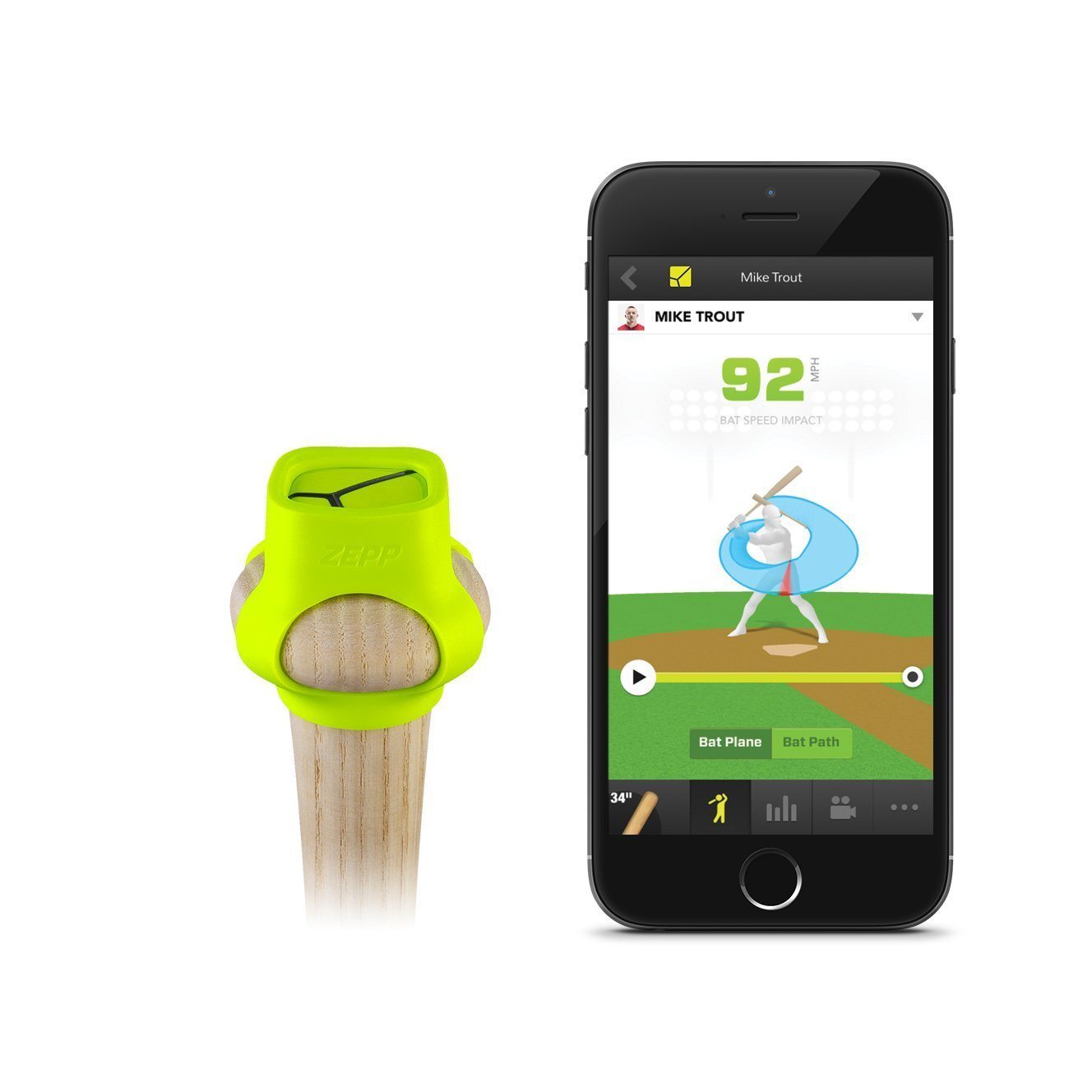
Headband's for men! 3D Baseball Swing Analyzers!
Wearable fitness technology has been all the rage for years now, and it's finally made it's way to your baseball swing. The Zepp 3D Baseball Swing Analyzer is our "BEST OVERALL" recommendation for Baseball Hitting Aids.
And for good reason...
This is a comprehensive tool that doesn't require high quality video or knowledgeable coaches to give you feedback. It's telling you what's wrong (or right) with your swing in real time, and with multiple metrics.
Crazy how Zepp help me with my swing....wish I had this 20 year ago!!!
Twitter - Oct 24 2014
What Metrics does the Zepp 3D Baseball Swing Analyzer Track?
In the video below, Mike Trout demonstrates how he uses his Zepp to create an "inside out swing" and drive the ball to right center field with authority.
Why the Zepp 3D Baseball Swing Analyzer is So Good
ZEPP 3D BASEBALL SWING ANALYZER
Hands down our favorite baseball hitting aid.
2. SKLZ Power Stick
The SKLZ Power Stick takes home our top prize for "BEST VALUE" because it's a great baseball hitting aid at the low price of $29.99 (at time of publishing this article).
That's a lot of bang for the buck. Let's take a look at what's so great about it.
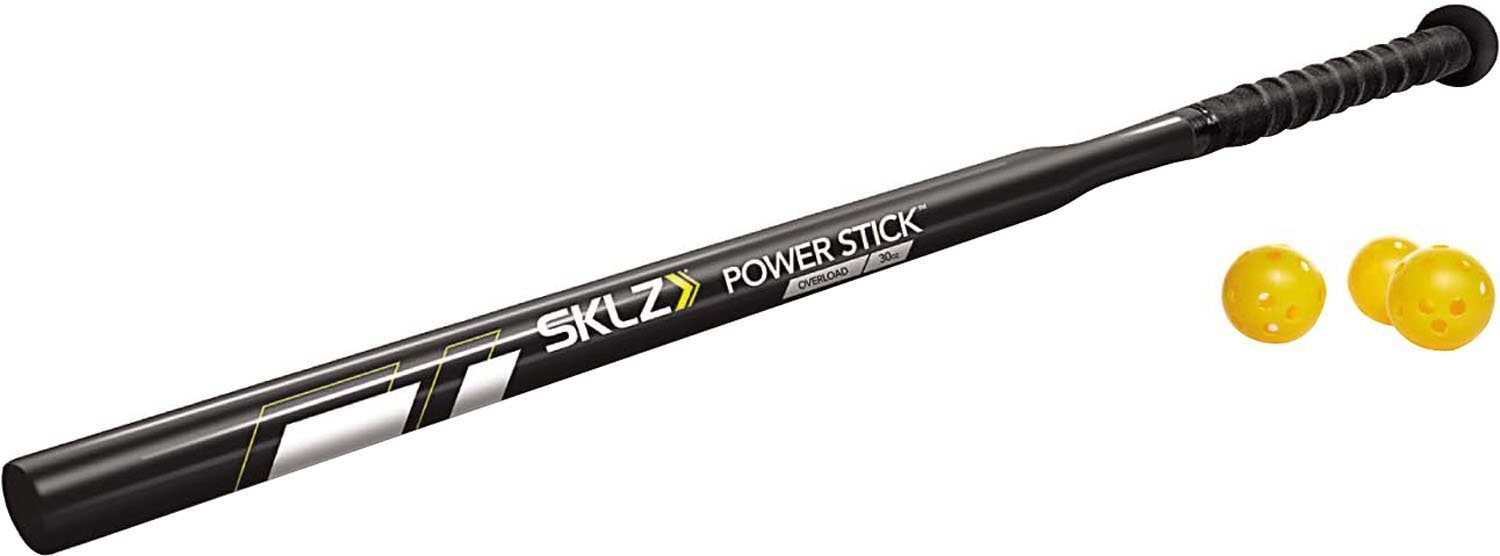
Contact, Contact, Contact
If you find yourself swinging and missing a lot, this might be the baseball hitting trainer for you.
What you get with the SKLZ Power Stick is a very narrow barrel designed to be used with golf-ball-sized wiffle balls. After a few rounds with this hitting aid, your hand eye coordination should pop off the charts. Don't stop until your hitting line drives!
Our 11u travel team has used this combined with the Total Control mini whiffle balls. Great for hand eye coordination and letting the ball travel deeper into the strike zone.
Dick's Sporting Goods Reviewer
Weight (there's more!)
The Power Stick (as opposed to it's light weight cousin, the Quick Stick) is slightly over-weighted, which means that in addition to training your hand eye coordination, it also strengthens the many muscles involved in a baseball swing.
After moving from this tool to a full sized bat, it feels like you're hitting a beachball with a 2x4. I use this tool for batting practice before every game, just to get in the zone.
SKLZ POWER STICK
No more swings and misses!
3. SKLZ Hurricane Category Four Batting Trainer
Most of the Baseball Hitting Aids we cover in this article are great for both kids, and more advanced players. However, it's the SKLZ Hurricane Category 4 Batting Trainer (that's a mouthful) that takes the top spot of "BEST FOR KIDS".
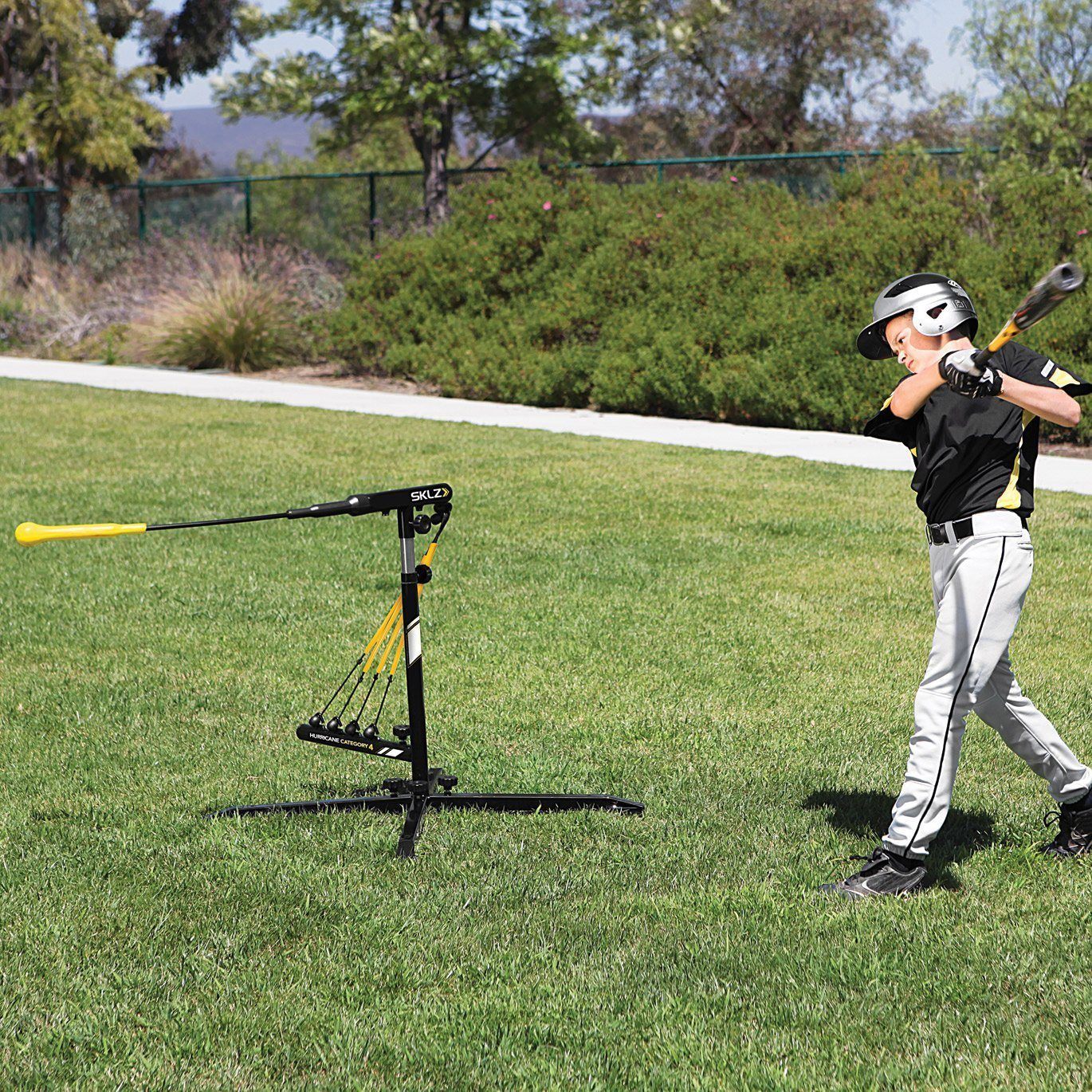
Repetition...
It's a tee baller's best friend. For kids at the very beginning levels of baseball, it's all about forming muscle memory - and that means repetition. Unfortunately, that also usually means tees, balls, and a net (and time).
But with the Hurricane (I'm shortening it for the duration of this article because wow) your kids can hit away for hours and not need to chase any balls around the yard etc. Not only that, but the path that the arm takes, after hitting the ball, gives you feedback on whether you are squaring the ball up or not.
You'll feel when you hit it square and when you hit it "off". After a summer of using this tool, you're kids should be showing improvements in contact skills and batting mechanics - and they can do it all on their own if you don't have the time to help.
Why it's so good:
SKLZ HURRICANE CATEGORY 4 BATTING TRAINER
Repetition and feedback without chasing balls. Hit in the back yard for HOURS.
4. Junior Hack Attack Baseball Pitching Machine
ATTENTION COACHES/PROGRAM DIRECTORS/RICH DADS:
You need this pitching machine. No really, you kind of need it. Watch the video below and tell me you aren't just a little bit excited about this hitting aid.
This machine does everything, is portable, throws multiple styles of pitches, and basically blows every other pitching machine away*
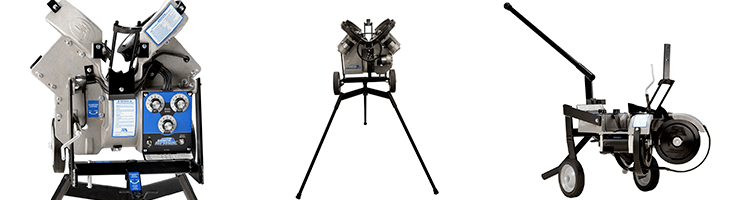
*Okay, so it doesn't necessarily blow every other machine away. In fact, Sports Attack makes another machine for $3,300.00 that is just like this one, but throws 100mph. I'm here to tell you that this is pointless.
A pitching machine that throws 70 mph will look like 85 mph to the average hitter. Why? Because without the benefit of timing a pitcher's motion, you're not picking up the ball as quickly from a pitching machine, thus making the reaction time necessary a little faster.
Also, if it's a 100mph fastball that you want - move the machine closer to the plate. Done.
But don't take my word for it...
I am a professional batting instructor who owns 2 hack attacks adult machines. I also own 2 bata machines and an older style jugs machine. The most significant advantage of the three wheel design is that the batter can clearly see the ball as it enters the wheels. This really is an advantage in terms of the batters timing. The machine is also probably a little bit more accurate overall.
Checkswing.com Forum User
SPORTS ATTACK BASEBALL PITCHING MACHINE
Fastballs, curves, sliders, pop-flys, grounders - just an overall BEAST of a machine that you need for your practices. Plus it will fit in the trunk of your car (when your wife kicks you out for being at the field too much).
5. SKLZ Hit-A-Way Baseball Swing Trainer
Okay, this is the first baseball hitting aid that I'm not going to recommend. At least not enthusiastically.
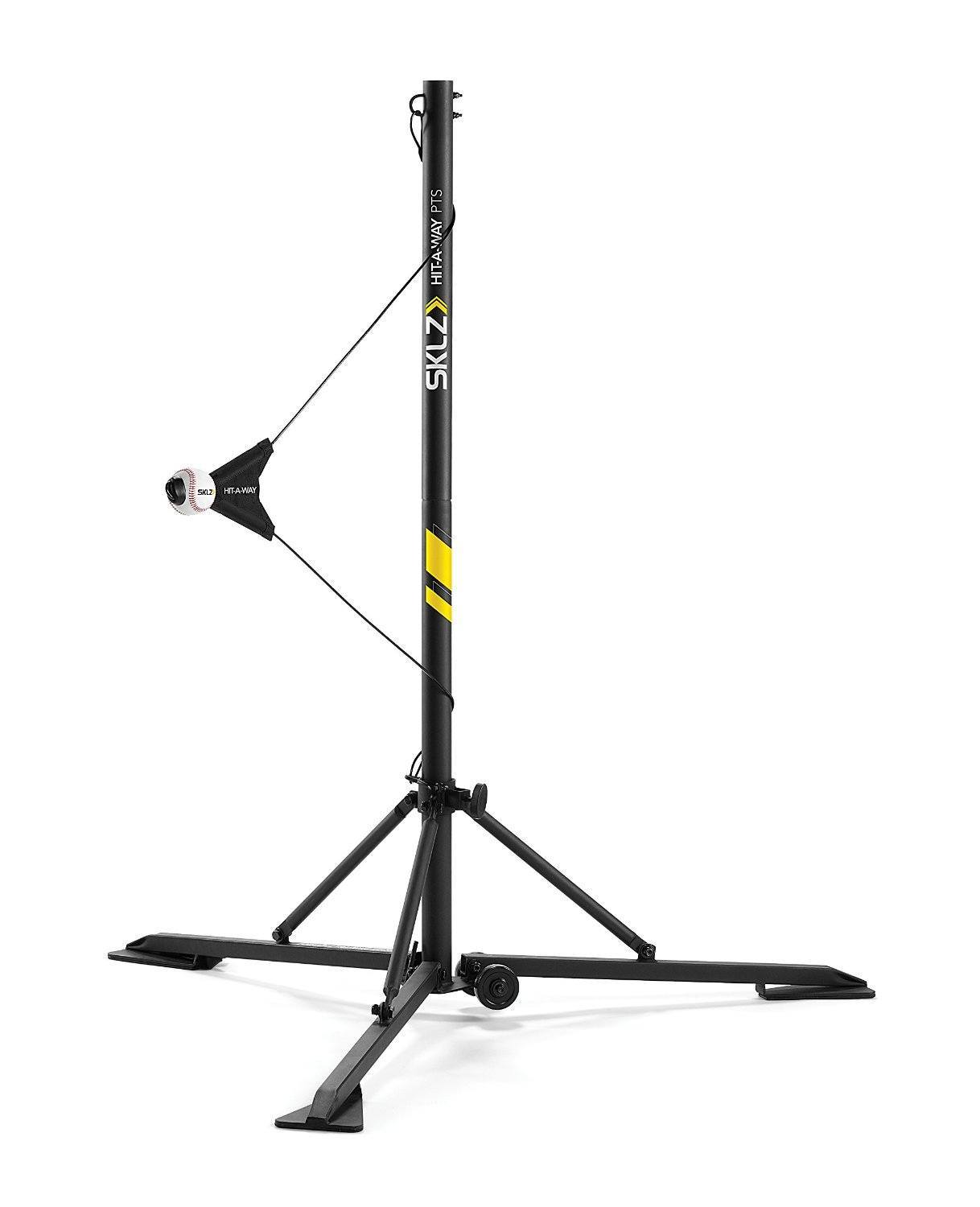
The SKLZ Hit-A-Way Baseball Swing Trainer actually gets very good reviews on Amazon. So take what I'm about to say with a grain of salt before you make a decision on this product.
However, I have personally used this product before and I wasn't a huge fan.
Why I didn't like the SKLZ Hit-A-Way
What I did like about the SKLZ Hit-A-Way
SKLZ HIT-A-WAY BASEBALL SWING TRAINER
I didn't care for it much, but others seem to LOVE it. Click here to discover which side you're on. Good luck!
6. Louisville Slugger L30325 Instructo Swing Batting Trainer
The Louisville Slugger L30325 is actually a really great hitting aid and it nearly made our "BEST RECOMMENDED" list. The best part of this tool is how it teaches you to keep your bat on plane with the ball.
There are a few different approaches to hitting, including "Rotational" and "Linear" - I delve into rotational hitting a little bit in this article. One of the benefit to this hitting tool is that it works with all hitting philosophies, so that no matter what you are teaching, this can help.

LOUISVILLE SLUGGER L30325 INSTRUCTO BATTING TEE
Get your swing on plane and keep it there! No more holes in your swing.
7. SKLZ Quickswing PX4
Ho Hum, another SKLZ Hitting Aid. Seriously, these guys have a million products. And most of them are pretty good.
The SKLZ Quickswing PX4 is designed with a few things in mind, but most importantly it's designed to improve bat speed.
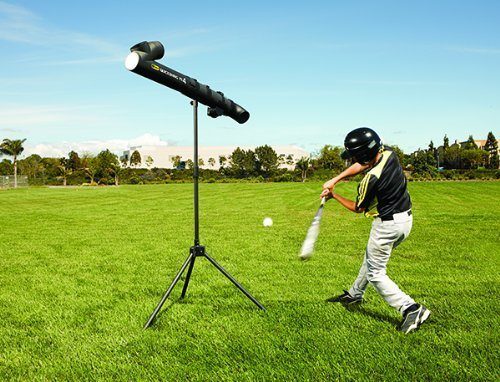
Bat Speed = Power
The quicker your bat, the farther you'll hit the ball. That's just science. The Quickswing makes it imperative to have a quick bat otherwise the ball will fall to the ground with a demoralizing thud.
And there's no great technology here, either. Just gravity. The SKLZ PX4 drops the ball straight down, leaving you very little time to react and drive the ball. You can see how this type of training aid could be beneficial in cultivating faster bat speed.
A tool like this is great for a two strike approach. It's great for when you're letting the ball get a little deeper before making the decision to swing or not.
Daniel Russell, a professor at Kettering University in Michigan, found that doubling the swing speed of a 30-ounce bat can raise a BBS of 62 mph to 83.8 mph -- a 35.1 percent increase. In terms of turning a hit into a homer: Against a 94-mph fastball, every 1-mph increase in swing speed extends distance about 8 ft.
popularmechanics.com
Benefits of the SKLZ Quickswing PX4
SKLZ QUICKSWING PX4
Improve your bat speed, reaction time, and hand eye coordination.
8. Hitters Power Drive
This is kind of an interesting hitting tool. I debated whether or not to include this on the list, but ultimately I decided that I would because it's different in every way from all the other hitting aids listed here.
The Pavlovian Hitting Aid
For those unfamiliar with Pavlov and his dogs, click here. Are we up to speed? Good.
The Hitter's Power Drive is all about conditioning yourself to shift your weight from the back to the front of your swing properly. And the way that it accomplishes this, is with the sound of a"click".
When you're using this tool correctly, and driving your lower half through the ball as you should be, you'll hear a click. Good dog, here's a treat. Over time, you'll take swings in the batter's box that utilize this technique without even having to think about it. That's the idea at least.
Watch the video below to get an idea of what the Power Drive has to offer.
HITTERS POWER DRIVE
Get your lower half working correctly and drive the ball with more power.
9. A Wooden Baseball Bat. Yes Just a Wooden Baseball Bat

maybe not this exact model.
Babe Ruth would be rolling in his grave if he saw what you were swinging in the batter's box - science's latest alloys, sweet spots bigger than the moon, and even ROTATING FREAKING HANDLES.
If the Bambino could have used one of those bats back in the day he would have hit 1500 homeruns.
But no, Babe Ruth used a wooden bat, and so does every single professional baseball player.
Why Are Wooden Bats Good For Training With?
Because it's harder to hit with them.
Wooden baseball bats are heavier, have smaller sweet spots, have less pop, and just overall require a greater level of skill to use properly.
And that's why you should never take batting practice again without a wooden bat in your hands.
You don't have to use it in a game. In fact, if you don't have to, you shouldn't. But if you're taking your batting practice cuts with one of these bad boys, you'll learn how to square up the ball more often.
Nobody likes hitting weak ground balls and shallow pop flys (especially in batting practice). Yet the more you use a wooden bat, the less of those you'll be hitting. You'd be surprised at how quickly you'll adjust to the smaller sweet spot on a wooden bat.
The feedback you get from the feeling of the ball off the bat is priceless. And nothing, I mean NOTHING, feels and sounds better than blasting a ball off of a wooden bat.
But Don't Wooden Bats Break?
Only when you're not squaring the ball up.
But I don't want you to buy a gazillion wooden bats either - my guess is, you're not sponsored by a major bat company like the pros are.
That's why they invented composite bats. These are bats that are made from composited wood, and are treated/designed to be harder to break - although you can definitely (and probably will) break them. God knows I have. Consider this a fair warning.
DeMarini D110 Pro Maple Composite Baseball Bat
For my money, this is the bat that you should consider for a batting practice bat. It's one of the hardest bats to break that I've ever swung. I've seen these things really take a licking. It doesn't have all that much pop, but it's a great bat on a budget.

There are plenty of wooden bats out there, both composite and real wood, that you should check out. It may take you a while to find the one that you like the best, but the results are totally worth it!
COMPOSITE WOODEN BATS ON AMAZON
Start using a real bat while taking batting practice and see just how awesome you are when transitioning back to an aluminum.
More...
Maybe you've heard the term "Five Tool Player" before and wondered what that meant. Or maybe you know the term, but want to learn how to achieve that lofty title. When I was a kid, I remember the first time that I heard someone use it. I didn't know exactly what it meant, but I knew that I wanted to be one - a five tool player that is.
So, what are the five tools in baseball?
Simply put, the five tools are the categories that scouts use to break down a player's abilities on the field. If you rate highly across all five tools, you're known as a five tool player and you're showered with love and money. Yay!
It should be noted that this applies to position players mostly, and not pitchers. Pitchers have a different scale with which they are rated.
The Five Tools in Baseball Are:
This is what scouts are looking for in a player. Let's break each one down a little further and see how you can improve in these areas.
Baseball Tool #1 - SPEED

In my opinion, Speed is one of the more underrated skills to have in baseball. It's always the home runs and fancy web-gems that get all the glory, but when you've got a speedy runner on the base paths, they can affect the outcome of the game in 100 different ways.
Here are a few of the ways that a fast runner can change a game:
The list goes on, but you get the point.
One important thing to mention here, is that, while we are referring to this tool as "speed", it also encompasses base running in general. There are plenty of guys that aren't breaking any records in the 40 yard dash, but still grade high in this tool based on their intelligence on the base paths.
Players such as Dustin Pedroia and Ryan Zimmerman are not very fast, but Pedroia has the uncanny ability to read the ball off the bat, take an extra base when he sees an opportunity, and steal the occasional base on lazy pitchers who have forgotten about him.
Zimmerman, although not very fast, ranks among the fastest players in the league for taking an extra base.
Our Favorite Resources For Speed
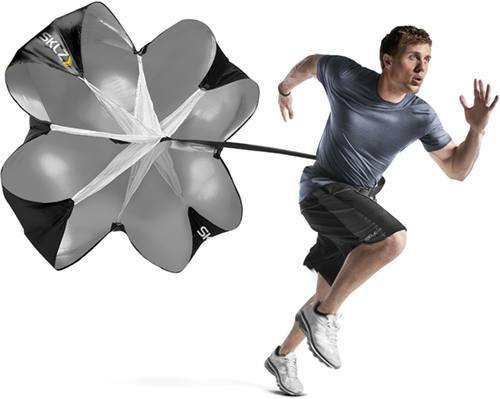
SKLZ Speed Parachute

Baseball Tool #2 - ARM STRENGTH

Just like speed, arm strength is another often overlooked tool in a baseball player's arsenal. As a position player, you may think that your arm strength "is what it is". So long as your throws are accurate, you don't give much extra thought into improving your velocity.
However, just as pitchers do, position players can also improve their velocity through many different exercises - or even just improving on your mechanics.
Having a strong arm can be the difference between gunning a runner down from the hole at shortstop, or letting another infield hit extend the inning.
First base is just about the only position on the diamond where you can hide a weak arm. Even second basemen need a certain amount of zip on the ball to turn double plays.
Our Favorite Resources For Arm Strength

SKLZ Weighted Baseballs
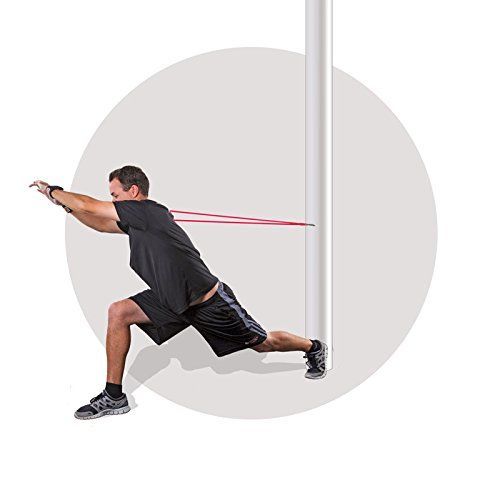
Jaeger Sports Arm Strength Bands
Baseball Tool #3 - FIELDING

Fielding your position well is KEY to having success on the baseball field, and being on a team that wins.
Let's not forget that baseball is a team sport.
So often, when writing about improving one's baseball skills, it can become easy to forget that you are just one of nine guys on the field pulling for the same goal. You have to do your job, so that everyone else can do theirs.
In all honesty, I'd rather have a guy on my team that plays great defense, than a guy who mashes homeruns. I've seen too many games blown, and thrown away, because of a few bad plays.
Plain and simple - you must work on your fielding constantly. There is never a time that you can rest, and feel comfortable with your abilities. Every day, you've got to be out there taking ground balls or shagging pop-flies. Every day.
Our Favorite Resources For Fielding

MacGregor Infield Training Glove
From Around The Web
Baseball Tool #4 - HITTING FOR AVERAGE

Hitting for average in baseball means that you are doing a few things right. Things like:
If you're checking each of these things off the list, it's almost impossible not to have a high average. But these things are easier said than done.
Even the best hitters in the game go through slumps. That's why you need to have consistency and trust in your batting approach. There are systems and tools out there to help you achieve that consistency. Hopefully, this site, is one of them.
Our Favorite Resources For Hitting for Average


SKLZ Power Stick


Tanner Tees
From Around The Web
Baseball Tool #5 - HITTING FOR POWER

The one you've been waiting for, right? I can't say I blame you. Homeruns are sexy. Power hitters get all the love (and media coverage). Personally, I've never hit for much power, and man, does it bother me sometimes. I'd love to know what it feels like to hit a ball like this:
Some people say that you can't teach power. But that's not true. In fact, I have an entire article on how to hit with more power.
And the more that I put these techniques into practice, the harder I'm starting to hit the ball. My goal is to hit one home run this season. Just one. I'll keep you posted.
Our Favorite Resources For Hitting for Power


Zepp 3D Baseball Swing Analyzer


SKLZ QuickSwing PX4
From Around The Web
What Are The Five Tools In Baseball?
A Re-Cap
Now that you know what the five tools are, it's time to go out and put them into action!
Be honest with yourself - what are you lacking? Some guys are freaks of nature and are born with these talents, but the rest of us have to fight for them. You can improve.
The resources listed here are meant to be a constantly updated list. If you have a suggestion for a training aid, or a workout, or a drill that helps develop any of these five tools, please leave a comment. I'm always on the lookout for the best information and tools available.
Baseball Season is here! And that means it's time to be overly critical of every at bat, play in the field, and failed stolen base attempt. As part of a series of posts this summer, I'll be breaking down my own performance, and seeing what lessons I can take away from every game.
I play in a men's adult baseball league called the National Adult Baseball Association (NABA for short).
More...
Game 1 - Hitmen vs. Snappers (yes those are the names)
If you're anything like me, you're really hard on yourself - and that's okay. We get better by being hard on ourselves. It only becomes a problem if you don't view your shortcomings as opportunities to learn.
But you can't beat yourself up. With that said, watch me beat myself up...
Offensive Breakdown
AB | R | H | RBI | BB | SO | PA | BA | OBP | SLG | OPS |
|---|---|---|---|---|---|---|---|---|---|---|
4 | 1 | 2 | 1 | 0 | 2 | 4 | .500 | .500 | 1.000 | 1.500 |
Triple, Single, RBI and Run Scored.
This looks pretty good at first glance. And I'm happy with it, in general. But you will notice that I struck out twice during this game - once looking and once swinging. I really hate striking out - it's such a waste of an at bat. But it's going to happen.
When a strikeout is unacceptable
A strikeout is unacceptable when there are men on second and third with one out. That's an unacceptable strikeout.
In a situation like that you have one job: put the ball in play. Preferably in the air - the harder the better. It's a moment that many hitters relish because you basically have complete freedom to swing aggressively.
Let me set the scene for you...
It's the bottom of the sixth inning. I'm due up fourth, and the first two runners have reached base via walk. The pitcher is a little wild this inning, is what I'm thinking. There are no outs and the hitter in front of me is smart, and he plays a little small ball, laying down a bunt. It's successful and he advances the runners with the sacrifice.
Now we have runners on second and third with one out. Did I mention it's a tied game? They pull the infield in to cut off the go-ahead run.
Normally, I go up to the plate in this situation thinking "take a hack".
But because of the two walks I'm thinking, "I might not get anything good to hit, let's see if he can throw strikes."
The first pitch is absolutely mouth watering. It's up in zone, it's flat, and it's a mediocre fastball. And I take it for a called strike. LIKE AN IDIOT. That is exactly the type of pitch that I should have been gearing up for.
Now it's 0-1. No time to panic, I just need a good pitch to hit. So what's he throw me? A good curveball that I take for another strike. It was a good pitch, I'll admit that, but still one that I could have hit.
Okay, so now it's 0-2 and I haven't swung the bat. Now we're in bad territory.
Here's where things can go a little haywire when you're in your head too much at the plate. I've seen two pitches - probably the only two pitches that this guy has. What will he come with next?
I shouldn't even be making a guess, in this situation. Instead, I should be looking fastball and adjusting to anything offspeed, and I should be protecting the plate. That's what I should be doing.
But, no, I'm guessing instead - and I'm thinking he's going to waste a pitch to see if I'll chase. I'm specifically thinking that he's going to throw another curve down and off the plate. So that's where I'm cheating.
I have to give the pitcher credit. He played me like a fiddle and whatever wildness he had in the beginning of the inning was apparently gone. He comes back with a fastball right under my hands - inside, but still catching the plate. Because I was looking out over the plate for something offspeed, I can't adjust to fastball in...
I swing, but can't get the barrel to catch up. Strike three.

A wasted opportunity. Now there are two outs in the inning, the infield can move back, and we can't produce a run with an out. I don't even remember what the batter after me did, but he made an out. Inning over. Game still tied. The game ended in a tie, by the way.
What I learned, in the end...
There are still a lot of positives to take away from the game. For one, we only scored 3 runs in the game total - I was responsible for driving one of them in, and scoring another. That's good. That's what I will take with me as a positive into the next game.
Are you playing right now? What lessons have you learned along the way?
So your kid needs a bat, and you want to find something good. But this is also youth baseball that we're talking about here, and they could outgrow this thing by next season, or worse, they might not even like baseball in a year's time.
This means you need a good bat on a budget. So what are your options?
More...
A Quick Overview of The Best Youth Baseball Bat Under $100
Top Youth Bats | Quality | Price | Rating |
|---|---|---|---|
A+ | $$$ | ||
A+ | $$ | ||
B+ | $$ | ||
B | $ |
*we didn't specifically review the Easton Mako Tee Ball Bat because it's really a beginner bat and it's hard to judge what is right for a kid at that age. If you're after a Tee Ball bat, this is a great option. In the $30-40 range - check out the details on Amazon.
How much do I need to spend on a youth baseball bat?
Obviously, this post is is geared towards an economical buying decision, but it still begs the question: How much should a parent look to spend on a baseball bat for their child? It's a complicated answer that depends on a few important factors.
How serious is your child?
If your kid is like I was growing up, then he lives and breathes baseball. If that's the case, then you'll probably want to look for something over the $100 mark. Even if it's a stretch for your wallet, it's probably worth it, because sometimes buying cheaper equipment just means it will get worn down quicker with a lot of usage.
Do you even need to buy a bat?
You may not even need to purchase a bat for your child. Many youth baseball programs will have some bats on hand for those without one. Or the few kids that do have bats will be kind enough to let your child borrow theirs during games. This is how I got through the majority of my youth baseball experience, to be honest with you.
What if my kid is serious, but I've got bills to pay, let's be real here?!
Good news! You're exactly who I wrote this article for! And you're not alone.
There are plenty of great youth baseball bats under $100 that are high quality and that your kid will love. But there are also some fisher price types that you'll want to avoid. So let's get into the nitty-gritty of it all shall we?
What makes a youth baseball bat a youth baseball bat?

Before you make a purchase you'll want to make sure that you're buying the right bat. Believe it or not, Little League Baseball has regulations against which types of bats can be used in their leagues.
I'll spare you most of the legal mumbo jumbo (click the link to get into the specifics), but at the lowest levels of little league the bat can not exceed 33" in length, nor can the barrel be larger than 2 1/4" in diameter. It also needs a BPF (Bat Performance Factor) of 1.15 or less.
What does that even mean?
It's basically a number that tells you how "lively" the ball will be off of the bat. The higher the number, the more pop the bat will have. By limiting the BPF at the lower levels of baseball they are saving your kids from possible batted ball injuries and you from some high orthodontic bills.
One Piece vs. Two Piece Youth Bats
If you've been researching youth baseball bats for a little bit, I'm sure you've noticed that they come in a few varieties, namely one piece and two piece.
There are varying opinions on which is superior, although the real answer to that question is that neither is superior, it just comes down to preference.
One Piece Youth Bats
PROS
CONS
Two Piece Youth Bats
PROS
CONS
Should I get my kid a wooden bat?
Definitely not for in game use. If you want to get your child a wooden bat, get them one to use in practice in addition to an aluminum or composite bat for game use.
However, I would suggest not getting a wood bat for your child until they are 12-13 years old. It's hard to hit with a wooden bat (which is why they're great for practice), but you don't want your kid to lose confidence in him/her self when swinging wood.
Wood bats also break. And that's not always the fault of the manufacturer. Most of the time it is not a result of bat quality at all, but rather hitting the ball off the handle or off the end of the bat. This causes such a severe vibration that the wood can't handle it.
You can break a wooden bat on the very first pitch. You don't want to be wiping tears off your child's face because they just ruined a new bat through no fault of their own.
The Top Youth Baseball Bats Under $100 Are...
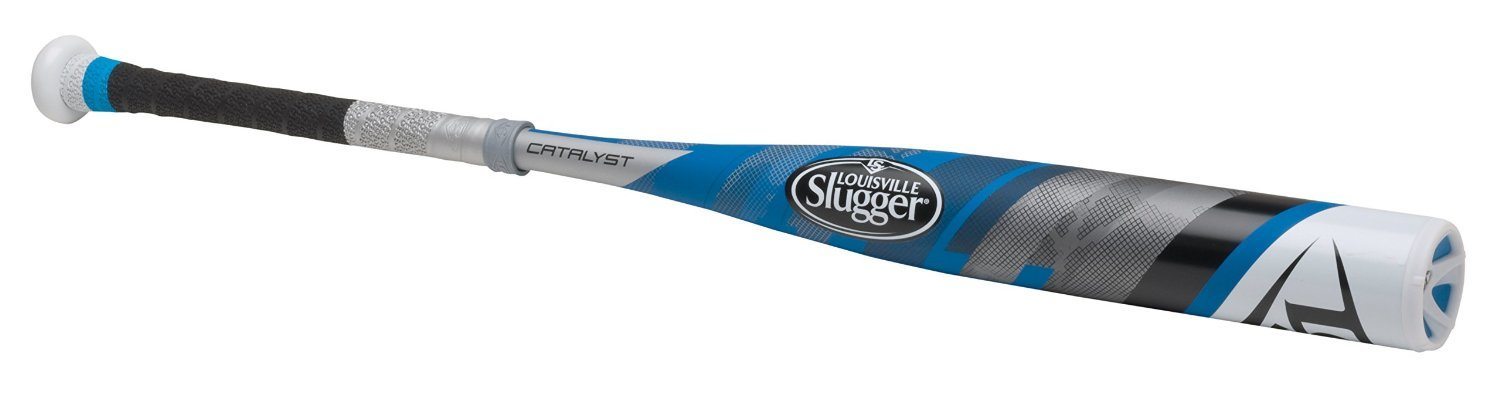
2015 LOUISVILLE SLUGGER CATALYST
A great composite bat that looks and swings fantastic!
Material | Weight Drop | Barrel Diameter | Handle Diameter |
|---|---|---|---|
C1C Composite | -12 | 2 1/4 | 7/8" Tapered |
The 2015 Louisville Slugger Catalyst is a great starter bat for any kid who loves the game. This is a single piece, composite bat, so it is very durable and lightweight. This comes in at -12 drop weight.
What is drop weight, you ask?
It's pretty simple really, it's just a way of relating the weight of the bat to the length of the bat. -12 means that this bat weighs 12 ounces less than the length in inches. Okay that sounded more confusing than it should be.
For instance, if you were buying this bat at 30" in length, than the weight would be 18 oz. Because 30 - 12 = 18. Make sense?
Why You'll Love It
we were looking for a good "bang for the buck" bat for our son. He loves this one. I enjoy watching the ball come off as quickly as it does. I hit a couple with it just to play and liked the feel of it in swing.
justbats.com reviewer
This bat is designed to be swung with ease. The 2015 model features a newly tapered handle which, although really up to the player's preference, offers more comfort during the swing.
Not only that, but this bat feels quick. Because it is. Having a drop weight of -12 allows the player to maximize his bat speed and get the barrel through the zone faster. If you're kid is having trouble catching up with fastballs, this may be the option for you.
Let's talk a little bit about the composite material
Composite material offers a few advantages over traditional aluminum alloys (and also a few disadvantages as well). The most notable advantage to a composite bat, in my opinion, is the weight distribution. The more even the weight distribution, the lighter the bat will feel while swinging.
Composite materials, because of their durable nature, allow for a more even weight distribution throughout the bat, which means that it will feel light in your child's hands. This works wonders for their confidence.
Click here to check the latest prices for the 2015 model of the Catalyst.
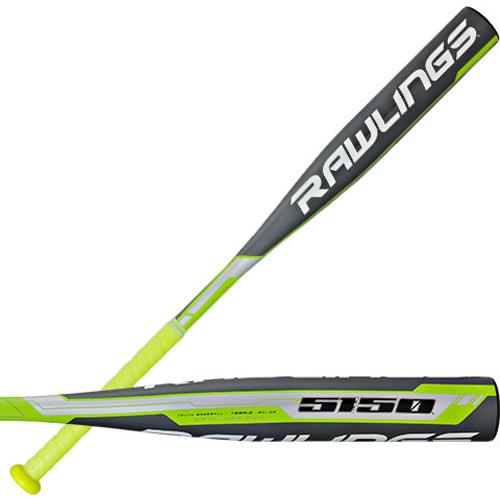
RAWLINGS 5150 YOUTH
An aluminum bat that packs the punch your kid is looking for!
Material | Weight Drop | Barrel Diameter | Construction |
|---|---|---|---|
Aerospace Grade Aluminum | -13 | 2 1/4 | One Piece |
This bat right here is a beast! And for the money they are asking (check the price on Amazon here), it's almost robbery. Almost.
I went back and forth about whether I should rank this as the number one option or not. Ultimately, I went with number two because of the sting factor. Because this is a one piece bat made from an aluminum alloy, you'll feel more vibration from a ball hit off the handle or end.
However! Because this is a one piece aluminum bat (made from an aerospace grade alloy) it really packs a lot of punch. If your kid isn't afraid of a little hand sting now and then, you should get them this bat.
Great ping and feel. My son was using a Rawlings Velo and He loves the new 5150.
justbats.com reviewer
Trampoline Effect
One of the great elements of this bat is the engineering that's gone into the barrel design - specifically the weight distribution. Rawlings has emphasized the "trampoline effect" to give this bat the utmost pop.
From their website:
Shaped from the radically responsive, aerospace-grade Rawlings 5150® Alloy, this one-piece construction equips hitters with expanded balance, transcending speed and magnified power. Rawlings' Precision Optimized Performance (pOp™) barrel technology as seen in the 5150®, isolates excess weight to a smaller region of the bat amplifying trampoline and generating additional barrel flex. Chosen by countless championship teams, the Rawlings 5150® gives new meaning to the phrase "power in numbers".
EASTON S3 YOUTH ALUMINUM
A wonderful aluminum option from the most respected manufacturer in the game!
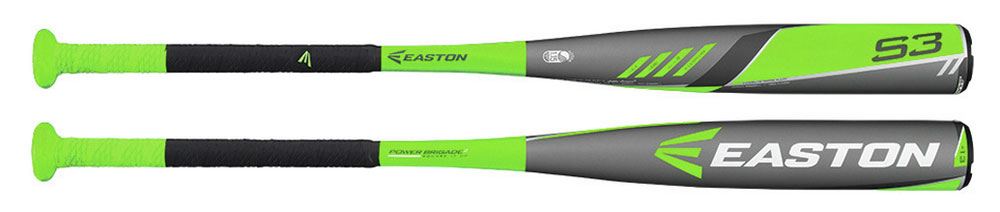
Material | Weight Drop | Barrel Diameter | Construction |
|---|---|---|---|
HMXATM Hyperlite Matrix Alloy (Aluminum) | -13 | 2 1/4 | One Piece |
Some kids just gotta have an Easton.
Full disclosure, the first bat that I ever owned was an Easton. It was a graphite composite bat, that in 1992 was way ahead of it's time.
And that's what Easton does best - engineer bats that are outside of the box, industry changing juggernauts.
Which is why it pains me to list this as the third best option. The Easton S3 is still a great option, don't get me wrong, but it's not quite at the same level as the previous two bats.
Why You'll Love it
Champions of this bat will point to the great pop that it provides. Much like the Rawlings 5150, this is a one piece, aluminum alloy bat. Which, as we know, means power and hand sting.
Contact, however, is what Easton touts the most about this bat. With an expanded sweet spot, and "Hyperskin" handle wrap, this bat is designed to provide great bat control with a forgiving barrel.
All of the characteristics that define the archetype of a "Contact Hitter" can be found in the new Easton S3 Youth Baseball Bat: YB16S313 - 1.) The S3 is forged from HMX (Hyperlite Matrix) Alloy for an expanded sweet spot and tremendous trampoline effect.
Why You May Not Love It
This is the only reason that this bat sits in third position.
There seem to be a lot of people leaving reviews of this bat that are not satisfied with it's durability. Specifically, people report that the bat can develop "flat spots" or dents. In Easton's defense, it's always tough to judge what a bat has gone through without owning it yourself.
For instance, these bats are not designed to be used in batting cages above certain speeds and over certain lengths of time. Have you ever seen a batting cage ball? They are way more dense than any baseball. They can destroy an aluminum bat quickly.
Also, these bats are designed for kids aged 7-10. There's a reason why these bats have a weight drop of -13, and it's that kids of this age don't generate as much bat speed and thus can handle a lighter bat without damaging it. The same is not true of an older brother or Dad hitting fly balls.
That's as far as my defense goes however, because at some point, where there's smoke, there's fire.
Check Amazon to learn more about the S3 and see for yourself if it's right for your child.
Did I miss a great option? Leave a comment and let me know!

news via inbox
Nulla turp dis cursus. Integer liberos euismod pretium faucibua
weekly popular