It really should be simple - how to hold a baseball bat, that is.
And, generally, it is simple, especially if you've been playing the game for a while. Most people don't give it that much thought. "Grip it and Rip it", they say.
But, lately, there's been two schools of thought on the proper way to grip a bat. And it seems like no one can get on the same page.
More...
Box Grip vs. Door Knocker Grip
Let me just get this out of the way before breaking these two different grip styles down: Either way is fine. In my opinion, it's more about a level of comfort than anything else. And if you're getting the results you desire, than there's no problem.
So, let's not get too stressed when discussing the pros and cons of both ways to hold the bat.
However, if you feel as though you're not hitting the ball as hard as you could be, you may want to consider something as simple as switching the way you hold the bat. Okay, here we go...
"Box Grip"

As you can see, the reason this style of holding a bat is called "box grip" is that it resembles a box with both pairs of your knuckles forming the sides.
This grip is very common among players of all ages and skill levels, and it's often the grip that feels the most natural.
This is the bat grip that I had for the majority of my playing years.
And honestly, it's the grip that you'll see the most often in video and images of professional baseball players. Especially the power hitters. This grip may be your best option for generating the most power from your swing. And power is good.
It accomplishes this because it promotes more torque through the swing by keeping your back elbow up, plus it's harder to roll your wrists over during or before contact. It accomplishes this because it makes it easier to keep the palm of your top hand facing up when making contact. That's all good stuff during swing mechanics.
But power isn't everything, and you may find that you prefer a different bat grip.
"Door Knocker Grip"

This bat grip gets it's name from the way your "door knocking knuckles" line up vertically on the bat handle.
I had not heard of this style until I was in my twenties. But one of my teammates started praising it as the "correct" way to hold a baseball bat.
I'm not sold on that, exactly, but I gave it a try. And I liked it.
It's a very comfortable grip that keeps the bat handle close to your fingertips. It gives me a lot of bat control, which for a contact hitter like myself, is key.
And that's who I feel this grip is more beneficial to - contact hitters. It gives you just a tiny fraction more of bat control, which could be the difference between a ground ball to second base, or a line drive up the middle.
As I said before, either one of these grips is acceptable, regardless of whatever else you hear on the internet. Experiment with what feels more comfortable to you. You may find that somewhere in between these two grips is what works for you. So be it.
The Most Important Things To Remember When Holding A Baseball Bat
Regardless of which school of a bat grip you fall under, there are some things that all coaches and players will agree on when it comes to how to hold a baseball bat.
Keep the Bat out of the Palms of Your Hands
If your baseball bat is buried in the palms of your hands, you are strangling it! Stop you murderer!
Actually, the only thing that you're murdering is your batting average.
Because when your bat is being held that deep in your hands, you're making it very hard to make the split second adjustments necessary to barrel up a pitch that can be breaking any number of ways or headed for any number of areas in the strike zone.
Letting your fingers control the bat allows you to have much better bat control.
Keep Your Grip Loose
Much like the aforementioned tip, keeping a loose grip on the bat improves bat control, but more so it increases bat speed, which increases power.
Loose muscles are fast muscles - and when it comes to a baseball swing, there are a million fast-twitch muscles involved in making the bat whip through the zone.
Next time your on the field, or in the cage with a tee, do this little test and you'll see what I'm talking about.
Take a hack while holding the bat as tightly as possible.
Then take a hack with as loose of a grip as you can (without losing grip of the bat obviously).
Notice a difference? Of course you do. The ball should jump of the bat when you're holding it loosely as opposed to merely thumping lifelessly off the bat while over gripping it.
Your batting grip will naturally tighten as needed as your swing progresses. Just keep it loose at the beginning of your swing and you'll have a much quicker bat.
How To Hold A Baseball Bat - What The Rest of the Internet Says...
eFastball.com has a great breakdown on this exact subject. It's full of lots of quotes from players and coaches - some of which are quite contradictory.
Check out this video from Antonelli Baseball
And, lastly, this video from Don Mattingly, which flies directly in the face of what many baseball experts on the internet preach when it comes to holding a baseball bat.
So Which Grip Do I Use?
Well, believe it or not, if you couldn't already tell by my lack of a true position on the topic - I use a grip slightly in between the two. Which I suppose is a grip that has been referred to as the "Rings Grip" elsewhere on the internet.
Which style of grip do you prefer? Leave a comment and let us know!

The Controversy on How to Hold a Baseball Bat
It really should be simple - how to hold a baseball bat, that is.
And, generally, it is simple, especially if you've been playing the game for a while. Most people don't give it that much thought. "Grip it and Rip it", they say.
But, lately, there's been two schools of thought on the proper way to grip a bat. And it seems like no one can get on the same page.
More...
Box Grip vs. Door Knocker Grip
Let me just get this out of the way before breaking these two different grip styles down: Either way is fine. In my opinion, it's more about a level of comfort than anything else. And if you're getting the results you desire, than there's no problem.
So, let's not get too stressed when discussing the pros and cons of both ways to hold the bat.
However, if you feel as though you're not hitting the ball as hard as you could be, you may want to consider something as simple as switching the way you hold the bat. Okay, here we go...
"Box Grip"
As you can see, the reason this style of holding a bat is called "box grip" is that it resembles a box with both pairs of your knuckles forming the sides.
This grip is very common among players of all ages and skill levels, and it's often the grip that feels the most natural.
This is the bat grip that I had for the majority of my playing years.
And honestly, it's the grip that you'll see the most often in video and images of professional baseball players. Especially the power hitters. This grip may be your best option for generating the most power from your swing. And power is good.
It accomplishes this because it promotes more torque through the swing by keeping your back elbow up, plus it's harder to roll your wrists over during or before contact. It accomplishes this because it makes it easier to keep the palm of your top hand facing up when making contact. That's all good stuff during swing mechanics.
But power isn't everything, and you may find that you prefer a different bat grip.
"Door Knocker Grip"
This bat grip gets it's name from the way your "door knocking knuckles" line up vertically on the bat handle.
I had not heard of this style until I was in my twenties. But one of my teammates started praising it as the "correct" way to hold a baseball bat.
I'm not sold on that, exactly, but I gave it a try. And I liked it.
It's a very comfortable grip that keeps the bat handle close to your fingertips. It gives me a lot of bat control, which for a contact hitter like myself, is key.
And that's who I feel this grip is more beneficial to - contact hitters. It gives you just a tiny fraction more of bat control, which could be the difference between a ground ball to second base, or a line drive up the middle.
As I said before, either one of these grips is acceptable, regardless of whatever else you hear on the internet. Experiment with what feels more comfortable to you. You may find that somewhere in between these two grips is what works for you. So be it.
The Most Important Things To Remember When Holding A Baseball Bat
Regardless of which school of a bat grip you fall under, there are some things that all coaches and players will agree on when it comes to how to hold a baseball bat.
Keep the Bat out of the Palms of Your Hands
If your baseball bat is buried in the palms of your hands, you are strangling it! Stop you murderer!
Actually, the only thing that you're murdering is your batting average.
Because when your bat is being held that deep in your hands, you're making it very hard to make the split second adjustments necessary to barrel up a pitch that can be breaking any number of ways or headed for any number of areas in the strike zone.
Letting your fingers control the bat allows you to have much better bat control.
Keep Your Grip Loose
Much like the aforementioned tip, keeping a loose grip on the bat improves bat control, but more so it increases bat speed, which increases power.
Loose muscles are fast muscles - and when it comes to a baseball swing, there are a million fast-twitch muscles involved in making the bat whip through the zone.
Next time your on the field, or in the cage with a tee, do this little test and you'll see what I'm talking about.
Take a hack while holding the bat as tightly as possible.
Then take a hack with as loose of a grip as you can (without losing grip of the bat obviously).
Notice a difference? Of course you do. The ball should jump of the bat when you're holding it loosely as opposed to merely thumping lifelessly off the bat while over gripping it.
Your batting grip will naturally tighten as needed as your swing progresses. Just keep it loose at the beginning of your swing and you'll have a much quicker bat.
How To Hold A Baseball Bat - What The Rest of the Internet Says...
eFastball.com has a great breakdown on this exact subject. It's full of lots of quotes from players and coaches - some of which are quite contradictory.
Check out this video from Antonelli Baseball
And, lastly, this video from Don Mattingly, which flies directly in the face of what many baseball experts on the internet preach when it comes to holding a baseball bat.
So Which Grip Do I Use?
Well, believe it or not, if you couldn't already tell by my lack of a true position on the topic - I use a grip slightly in between the two. Which I suppose is a grip that has been referred to as the "Rings Grip" elsewhere on the internet.
Which style of grip do you prefer? Leave a comment and let us know!
editor's pick

latest video

news via inbox
Nulla turp dis cursus. Integer liberos euismod pretium faucibua
you might also like
- You must keep your hands inside the baseball. If you let your hands drift out (having a long swing), you're going to get jammed or you're going to pull the ball foul.
- You still have to be able to get your arms extended. This means that you need to hit the ball out in front of the plate.
- You need to clear your hips early. This is part of rotational hitting which is something that I will go into depth on in another article.
- First off, you need a good eye. There's high heat, and then there's "this ball is up around my eyes" heat. Don't swing at balls out of the zone.
- Get your front foot down early. You need to be able to react quickly once you recognize that the ball is up. If you're foot is down, you're ready to pounce
- Work on timing the pitcher's fastball in the on deck circle. Get a feel for his rhythm and adjust your load and swing accordingly.
- Keep your swing short. Check out the drill below from Dead Red Hitting to help work on this.
- Single piece design offers more power
- More stability/Longer life
- "Feel" your mis-hits
- High probability of hand sting
- Requires more bat speed to produce power
- Limited in option of materials used.
- Sting resistant on mis-hits
- Ability to combine different materials in one bat (ie: aluminum barrel with composite handle)
- Lighter feeling handle = more bat control
- Less Power than single piece
- More complex construction = more chance for failure
- Knowing where to place the tee, is just as important as knowing how to use it
- Trying to go the other way on a tee might not be possible depending on where you place it.
- Focus on getting to your "load" position in the most simple way possible. Avoid too much "dancing".
- Think up the middle and the other way, but swing naturally not worrying about trying to place it there.
You want to know how to hit a baseball with more power?
Well, before we do that, I'm just going to go ahead and leave this epic blast for your viewing pleasure. Take your time, watch this video, wipe the tears from your eyes, and then we'll get down to business.
It's a thing of beauty, the way Bonds turns on that pitch.
More...
And, yeah, I know, steroids etc... But I'm just going to pretend that those years in baseball when Bonds, McGuire, and Sosa were turning baseballs into dust, were just gifts from the Baseball Gods above.
But let's assume that you're not blessed with the pure swing of a Mike Trout - or the freak, once in a generation talent, of Bryce Harper (who was doing this when he was in High School).
What can you do to add some power to that swing of yours? Well, besides hitting the weight room, Here's a few tips to add a few feet to your tape measure shots.
Learn to Turn on an Inside Fastball
Dustin Pedroia is listed at 5'9" and 175 lbs. That's pretty small for a pro ball player. Yet in 2008, his MVP season, he slugged .493 with an OPS of .869 - so how does a guy that small hit with so much power?
Because he absolutely feasts on inside fastballs - especially ones that are up in the zone. Because of this, he is able to generate a lot of power to his pull side.
Take a look at the chart below. It shows the location of pitches where Pedroia is hitting for the most power (slugging). The trend is pretty clear.

This can be a really hard thing to do for a lot of people (myself included). But there are a few things to keep in mind when trying to accomplish this.
Catch Up with High Heat
They say when life gives you lemons, make lemonade. Well I say, when a pitcher gives you a high fastball, put it in the bleachers.
Pitchers hate to leave balls up in the zone - and for good reason, they get crushed. But sometimes pitchers get cocky and think that they can beat you up there with their velocity. This is where you make them pay.
Why is it easier to hit a baseball with more power when it is up in the zone? Because it allows your bat path to stay flatter, increasing your ability to hit the ball just under center, which generates a lot of power.
So how do you catch up with a high fastball?
Keep your Hands Back
A lot of younger players struggle with keeping their hands back during the "loading" phase of their swing. As they start to take their stride their hands will either drift forward, drop down, or do both.
The problem is that you've just drained a lot of power from your swing by doing this, not to mention probably shortened the amount of time that your bat will be on the same plane as the ball (which is key to making good, hard contact, consistently).
Antonelli Baseball breaks this idea down in the video below.
Stop Squishing the Bug
ATTENTION TEE BALL DADS: Please stop teaching your kids this.
I don't know who started this trend, but I remember playing Tee Ball and hearing this all the time.
I can understand why it's taught - sometimes kids don't understand the role that their lower half has in the baseball swing (although some kids will just get it naturally). So when you want to get a kid to use his hips more, you tell him "squish the bug" so that he'll open up during the swing.
Here's the problem. When you spin your foot like this, you wind up putting all of the weight on your back leg - and it never gets transferred forward. Transferring your weight forward and through the ball is HUGE in creating power and bat speed.
Are these guys "squishing the bug" at contact?


In fact, often times when a professional makes contact, their back foot isn't even on the ground, that's how much force is being driven through the baseball...


Rich at the Baseball Barn has a great video explaining these principles. Check it out below.
What about you guys? What other tips can you offer up to increase the power in your baseball swing? Post in the comments below.
So your kid needs a bat, and you want to find something good. But this is also youth baseball that we're talking about here, and they could outgrow this thing by next season, or worse, they might not even like baseball in a year's time.
This means you need a good bat on a budget. So what are your options?
More...
A Quick Overview of The Best Youth Baseball Bat Under $100
Top Youth Bats | Quality | Price | Rating |
|---|---|---|---|
A+ | $$$ | ||
A+ | $$ | ||
B+ | $$ | ||
B | $ |
*we didn't specifically review the Easton Mako Tee Ball Bat because it's really a beginner bat and it's hard to judge what is right for a kid at that age. If you're after a Tee Ball bat, this is a great option. In the $30-40 range - check out the details on Amazon.
How much do I need to spend on a youth baseball bat?
Obviously, this post is is geared towards an economical buying decision, but it still begs the question: How much should a parent look to spend on a baseball bat for their child? It's a complicated answer that depends on a few important factors.
How serious is your child?
If your kid is like I was growing up, then he lives and breathes baseball. If that's the case, then you'll probably want to look for something over the $100 mark. Even if it's a stretch for your wallet, it's probably worth it, because sometimes buying cheaper equipment just means it will get worn down quicker with a lot of usage.
Do you even need to buy a bat?
You may not even need to purchase a bat for your child. Many youth baseball programs will have some bats on hand for those without one. Or the few kids that do have bats will be kind enough to let your child borrow theirs during games. This is how I got through the majority of my youth baseball experience, to be honest with you.
What if my kid is serious, but I've got bills to pay, let's be real here?!
Good news! You're exactly who I wrote this article for! And you're not alone.
There are plenty of great youth baseball bats under $100 that are high quality and that your kid will love. But there are also some fisher price types that you'll want to avoid. So let's get into the nitty-gritty of it all shall we?
What makes a youth baseball bat a youth baseball bat?

Before you make a purchase you'll want to make sure that you're buying the right bat. Believe it or not, Little League Baseball has regulations against which types of bats can be used in their leagues.
I'll spare you most of the legal mumbo jumbo (click the link to get into the specifics), but at the lowest levels of little league the bat can not exceed 33" in length, nor can the barrel be larger than 2 1/4" in diameter. It also needs a BPF (Bat Performance Factor) of 1.15 or less.
What does that even mean?
It's basically a number that tells you how "lively" the ball will be off of the bat. The higher the number, the more pop the bat will have. By limiting the BPF at the lower levels of baseball they are saving your kids from possible batted ball injuries and you from some high orthodontic bills.
One Piece vs. Two Piece Youth Bats
If you've been researching youth baseball bats for a little bit, I'm sure you've noticed that they come in a few varieties, namely one piece and two piece.
There are varying opinions on which is superior, although the real answer to that question is that neither is superior, it just comes down to preference.
One Piece Youth Bats
PROS
CONS
Two Piece Youth Bats
PROS
CONS
Should I get my kid a wooden bat?
Definitely not for in game use. If you want to get your child a wooden bat, get them one to use in practice in addition to an aluminum or composite bat for game use.
However, I would suggest not getting a wood bat for your child until they are 12-13 years old. It's hard to hit with a wooden bat (which is why they're great for practice), but you don't want your kid to lose confidence in him/her self when swinging wood.
Wood bats also break. And that's not always the fault of the manufacturer. Most of the time it is not a result of bat quality at all, but rather hitting the ball off the handle or off the end of the bat. This causes such a severe vibration that the wood can't handle it.
You can break a wooden bat on the very first pitch. You don't want to be wiping tears off your child's face because they just ruined a new bat through no fault of their own.
The Top Youth Baseball Bats Under $100 Are...
2015 LOUISVILLE SLUGGER CATALYST
A great composite bat that looks and swings fantastic!
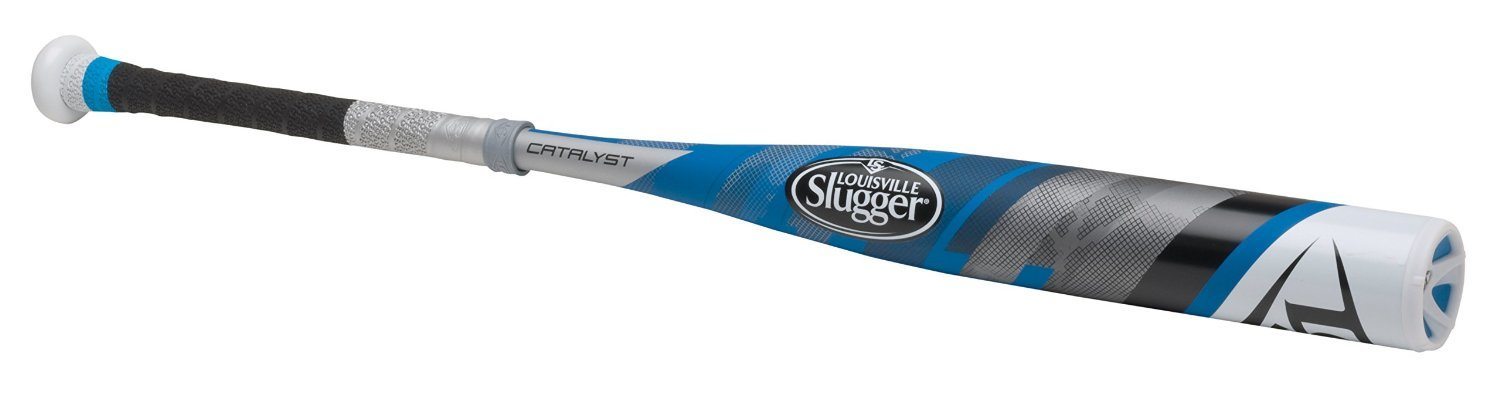
Material | Weight Drop | Barrel Diameter | Handle Diameter |
|---|---|---|---|
C1C Composite | -12 | 2 1/4 | 7/8" Tapered |
The 2015 Louisville Slugger Catalyst is a great starter bat for any kid who loves the game. This is a single piece, composite bat, so it is very durable and lightweight. This comes in at -12 drop weight.
What is drop weight, you ask?
It's pretty simple really, it's just a way of relating the weight of the bat to the length of the bat. -12 means that this bat weighs 12 ounces less than the length in inches. Okay that sounded more confusing than it should be.
For instance, if you were buying this bat at 30" in length, than the weight would be 18 oz. Because 30 - 12 = 18. Make sense?
Why You'll Love It
we were looking for a good "bang for the buck" bat for our son. He loves this one. I enjoy watching the ball come off as quickly as it does. I hit a couple with it just to play and liked the feel of it in swing.
justbats.com reviewer
This bat is designed to be swung with ease. The 2015 model features a newly tapered handle which, although really up to the player's preference, offers more comfort during the swing.
Not only that, but this bat feels quick. Because it is. Having a drop weight of -12 allows the player to maximize his bat speed and get the barrel through the zone faster. If you're kid is having trouble catching up with fastballs, this may be the option for you.
Let's talk a little bit about the composite material
Composite material offers a few advantages over traditional aluminum alloys (and also a few disadvantages as well). The most notable advantage to a composite bat, in my opinion, is the weight distribution. The more even the weight distribution, the lighter the bat will feel while swinging.
Composite materials, because of their durable nature, allow for a more even weight distribution throughout the bat, which means that it will feel light in your child's hands. This works wonders for their confidence.
Click here to check the latest prices for the 2015 model of the Catalyst.
RAWLINGS 5150 YOUTH
An aluminum bat that packs the punch your kid is looking for!
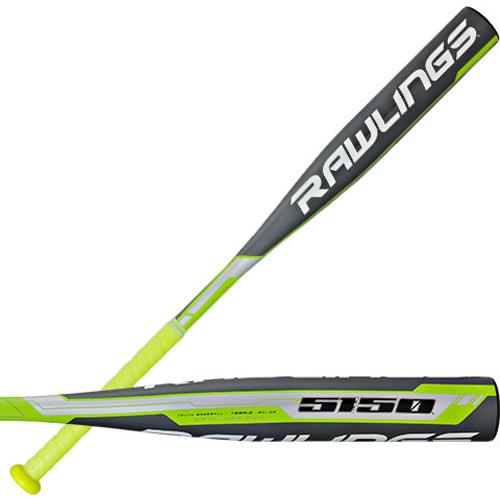
Material | Weight Drop | Barrel Diameter | Construction |
|---|---|---|---|
Aerospace Grade Aluminum | -13 | 2 1/4 | One Piece |
This bat right here is a beast! And for the money they are asking (check the price on Amazon here), it's almost robbery. Almost.
I went back and forth about whether I should rank this as the number one option or not. Ultimately, I went with number two because of the sting factor. Because this is a one piece bat made from an aluminum alloy, you'll feel more vibration from a ball hit off the handle or end.
However! Because this is a one piece aluminum bat (made from an aerospace grade alloy) it really packs a lot of punch. If your kid isn't afraid of a little hand sting now and then, you should get them this bat.
Great ping and feel. My son was using a Rawlings Velo and He loves the new 5150.
justbats.com reviewer
Trampoline Effect
One of the great elements of this bat is the engineering that's gone into the barrel design - specifically the weight distribution. Rawlings has emphasized the "trampoline effect" to give this bat the utmost pop.
From their website:
Shaped from the radically responsive, aerospace-grade Rawlings 5150® Alloy, this one-piece construction equips hitters with expanded balance, transcending speed and magnified power. Rawlings' Precision Optimized Performance (pOp™) barrel technology as seen in the 5150®, isolates excess weight to a smaller region of the bat amplifying trampoline and generating additional barrel flex. Chosen by countless championship teams, the Rawlings 5150® gives new meaning to the phrase "power in numbers".
EASTON S3 YOUTH ALUMINUM
A wonderful aluminum option from the most respected manufacturer in the game!
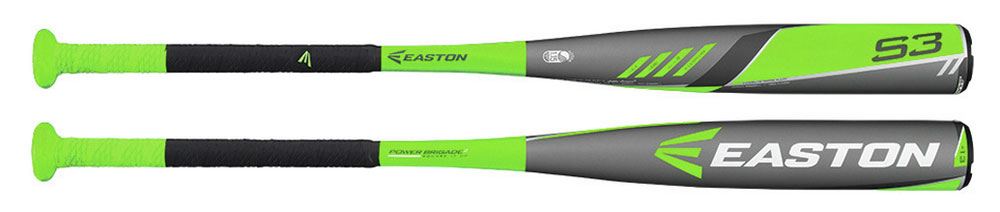
Material | Weight Drop | Barrel Diameter | Construction |
|---|---|---|---|
HMXATM Hyperlite Matrix Alloy (Aluminum) | -13 | 2 1/4 | One Piece |
Some kids just gotta have an Easton.
Full disclosure, the first bat that I ever owned was an Easton. It was a graphite composite bat, that in 1992 was way ahead of it's time.
And that's what Easton does best - engineer bats that are outside of the box, industry changing juggernauts.
Which is why it pains me to list this as the third best option. The Easton S3 is still a great option, don't get me wrong, but it's not quite at the same level as the previous two bats.
Why You'll Love it
Champions of this bat will point to the great pop that it provides. Much like the Rawlings 5150, this is a one piece, aluminum alloy bat. Which, as we know, means power and hand sting.
Contact, however, is what Easton touts the most about this bat. With an expanded sweet spot, and "Hyperskin" handle wrap, this bat is designed to provide great bat control with a forgiving barrel.
All of the characteristics that define the archetype of a "Contact Hitter" can be found in the new Easton S3 Youth Baseball Bat: YB16S313 - 1.) The S3 is forged from HMX (Hyperlite Matrix) Alloy for an expanded sweet spot and tremendous trampoline effect.
Why You May Not Love It
This is the only reason that this bat sits in third position.
There seem to be a lot of people leaving reviews of this bat that are not satisfied with it's durability. Specifically, people report that the bat can develop "flat spots" or dents. In Easton's defense, it's always tough to judge what a bat has gone through without owning it yourself.
For instance, these bats are not designed to be used in batting cages above certain speeds and over certain lengths of time. Have you ever seen a batting cage ball? They are way more dense than any baseball. They can destroy an aluminum bat quickly.
Also, these bats are designed for kids aged 7-10. There's a reason why these bats have a weight drop of -13, and it's that kids of this age don't generate as much bat speed and thus can handle a lighter bat without damaging it. The same is not true of an older brother or Dad hitting fly balls.
That's as far as my defense goes however, because at some point, where there's smoke, there's fire.
Check Amazon to learn more about the S3 and see for yourself if it's right for your child.
Did I miss a great option? Leave a comment and let me know!
Tee Work. Two dreaded words in a young baseball player's vocabulary.
More...
I remember going station to station during high school baseball practice and feeling underwhelmed by the work that I was getting in on the tee.
I mean, the ball's just sitting there - if I don't have the hand eye coordination to handle this by now then I may as well just give up.
So I'd go through the motions. Hit three to four dozen balls off the tee and move on to something more exciting like actual live pitching or at the very least soft toss.
This Was Me Being Dumb and Having Bad Coaches.
The truth is, knowing how to go about tee work is half the battle. And knowing the specifics of what you hope to accomplish during your work can go a long, long way.
MLB coaches and players know this, which is why they still do it on a daily basis, but especially during spring training when the pros are trying to get their swings back in check.
In this clip from the MLB Network, Curtis Granderson and Kevin Long (The former Yankees and now Mets' batting coach) break down some of the mistakes that Granderson made in the past during his tee work. They also touch upon what they hope to accomplish as they're getting their work in.
The Key Tee Work Takeaways
And there you have it, simple tee work from a pro.
By the way, the Tee they are using in this video just so happens to be the tee that I recommend as one of my favorite hitting resources, here.
