
- Balance is your best friend. Aim to be in a balanced, athletic position as the pitcher is in his or her windup.
- Be aware of the location of your hands. In general, you don't want them too high or too low as the ball is approaching. The less that you have to move your hands up and down to get on plane with the ball, the better. I like mine to be just below ear level during my stance.
- Try to limit bat movement, but not to the point that you feel "frozen" in the box. It's good to stay loose, but there's no need to get all "Gary Sheffield" in your stance when you're just starting out.

- Knowing where to place the tee, is just as important as knowing how to use it
- Trying to go the other way on a tee might not be possible depending on where you place it.
- Focus on getting to your "load" position in the most simple way possible. Avoid too much "dancing".
- Think up the middle and the other way, but swing naturally not worrying about trying to place it there.

Tee Work. Two dreaded words in a young baseball player's […]
- Trust in your bat speed and ability to hit a good fastball
- Once again, don't overthink your at bats in general. See the ball, hit the ball.
- Go the other way, go the other way, go the other way!

- Single piece design offers more power
- More stability/Longer life
- "Feel" your mis-hits
- High probability of hand sting
- Requires more bat speed to produce power
- Limited in option of materials used.
- Sting resistant on mis-hits
- Ability to combine different materials in one bat (ie: aluminum barrel with composite handle)
- Lighter feeling handle = more bat control
- Less Power than single piece
- More complex construction = more chance for failure
- Don't try and guess pitches when you're down 0-2
- Don't overthink your at bats in general. See the ball, hit the ball.
- With runners on second and third with one out, be extremely aggressive. Had I attacked that first pitch, we probably score a run there.

Baseball Season is here! And that means it's time to […]
I hate to break it to you, but you don't have the proper batting stance. Nope. Sorry. You just don't have it.
Why, you ask?
More...
Because as much as the baseball gurus, or your little league coach, or that overbearing neighborhood dad wants to tell you, there is no such thing as a "proper" batting stance.
There are weird batting stances. And there normal batting stances. And then there's yours, maybe somewhere in the middle. But if you're comfortable in the batter's box, then congratulations!
You... have a proper stance.
But, wait, it's not that simple...
No, of course it's not. You can't just stand there all knotted up and crazy and expect to be in a good hitting position when the ball is thrown.
You see, the crazier your stance is, the more movement you'll need to take to get back to a good, balanced, load position when the ball is being released. But as long as you can get there, you'll be fine.
Just look at these notoriously weird batting stances:

Weird Stance

Normal Load Position

Really Bizarre Stance

Totally Normal Load Position

Weird Stance

Normal Load Position

Weird Stance

Normal Load Position
As you can see, they all get to a good load position, regardless of where they start from. Even the strangest of these batting stances only lasts until the ball is being released by the pitcher, and then, everyone is more or less the same.
Timing is Everything...
You're timing is more or less the most crucial part of your swing, at least in terms of being able to make contact on a consistent basis. So, rather than focusing on how far apart your feet are in the box, or whether you have a "proper batting stance". Just focus on whether you can get into a rhythm with the opposing pitcher.
When I'm on deck, assuming that I'm loosened up, the only thing I'm trying to do is time the pitcher. Where do I need to be in relation to the pitcher's motion to put me in a successful pose to drive the ball.
My actual batting stance has very little to do with that.
So There Really is No Proper Batting Stance?
In my opinion, no.
But if you're a little league coach reading this, or a kid just starting out, there are a few basics to keep in mind when trying to find your comfort zone in the batter's box.
So there you go. Don't sweat about your stance. Just be comfortable, confident, and be ready to attack the baseball when you see a fat pitch right down the middle. Good luck!
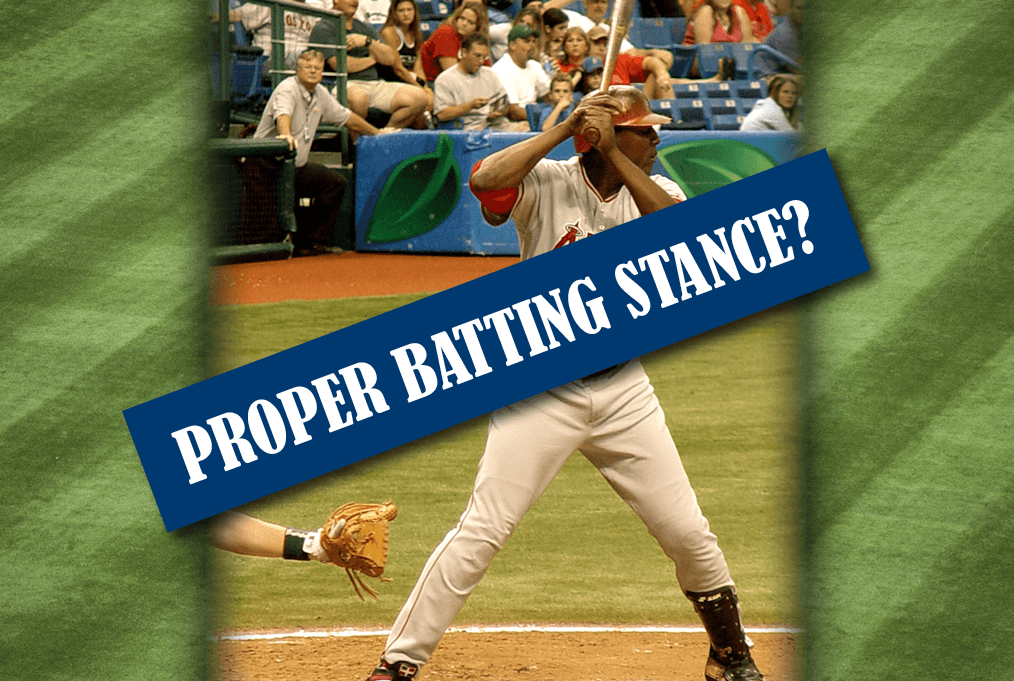
Tee Work. Two dreaded words in a young baseball player's vocabulary.
More...
I remember going station to station during high school baseball practice and feeling underwhelmed by the work that I was getting in on the tee.
I mean, the ball's just sitting there - if I don't have the hand eye coordination to handle this by now then I may as well just give up.
So I'd go through the motions. Hit three to four dozen balls off the tee and move on to something more exciting like actual live pitching or at the very least soft toss.
This Was Me Being Dumb and Having Bad Coaches.
The truth is, knowing how to go about tee work is half the battle. And knowing the specifics of what you hope to accomplish during your work can go a long, long way.
MLB coaches and players know this, which is why they still do it on a daily basis, but especially during spring training when the pros are trying to get their swings back in check.
In this clip from the MLB Network, Curtis Granderson and Kevin Long (The former Yankees and now Mets' batting coach) break down some of the mistakes that Granderson made in the past during his tee work. They also touch upon what they hope to accomplish as they're getting their work in.
The Key Tee Work Takeaways
And there you have it, simple tee work from a pro.
By the way, the Tee they are using in this video just so happens to be the tee that I recommend as one of my favorite hitting resources, here.
Baseball Season is here! And that means it's time to be overly critical of every at bat, play in the field, and failed stolen base attempt. As part of a series of posts this summer, I'll be breaking down my own performance, and seeing what lessons I can take away from every game.
I play in a men's adult baseball league called the National Adult Baseball Association (NABA for short).
More...
Game 2 - Hitmen vs. Aces (yes those are the names)
If you're anything like me, you're really hard on yourself - and that's okay. We get better by being hard on ourselves. It only becomes a problem if you don't view your shortcomings as opportunities to learn.
But you can't beat yourself up. With that said, watch me beat myself up...
Offensive Breakdown
AB | R | H | RBI | BB | SO | PA | BA | OBP | SLG | OPS |
|---|---|---|---|---|---|---|---|---|---|---|
3 | 1 | 0 | 0 | 1 | 2 | 4 | .286 | .375 | .571 | .946 |
2 Ks, a Walk, and a Pop Up. Not a great day.
What's up with the Strikeouts?
If you've been following along thus far in my season, you'll notice that this is the second game in a row where I've struck out twice.
No one likes striking out. Especially me, because I pride myself on being a contact hitter and I don't have the type of power (or any, really) that will allow for strikeouts to be acceptable.
So how did I get myself into trouble this time around? How did a good contact hitter like myself strikeout twice in one game?
Velocity Changes Everything, That's Why
We happened to be facing a few pitchers on this particular day that threw hard (hard for the league I'm in at least) - mid to high eighties, probably.
It's a hittable speed, honestly. And I don't say that to sound tough, but you can still time an eighty mph fastball even with just average bat speed. But you have to recognize the pitch early. That's where the problem lies.
When you start getting in your head about your ability to catch up with a fastball, you start to cheat rather than let the pitch come to you, see it, and react.
I Always Like to Take a Strike
It's the leadoff hitter in me. I always like to see a strike before I will swing at anything. That's a fine approach when you have good contact skills, because you don't have to worry all that much about being down two strikes. You can always foul off pitches until you get one you like.
But, it can sometimes put you behind in the count right away. And that's what was happening today. Good fastballs down the middle to start at bats. Pitches that I could have been aggressive on.
So now that I'm behind in the count, I get a little less aggressive, and also a little more paranoid about that fastball. which means...
I'm Now Susceptible to Offspeed Pitches
And that's exactly what I strike out on. I see a pitch that looks like a fastball out of the pitchers hand, and it's right down the middle. I start my swing early only to realize that, wait, that's not a fastball. It's a curveball and it's heading down and away.
I'm way out in front of the pitch and I can't adjust my swing in time. Strike three.
It's the same thing with a change up, but even worse, because those really look like fastballs coming out of the pitcher's hand because the arm speed is usually the same.
All I really needed to do is relax and not fear the fastball. I can catch up with it. I don't need to cheat and start my swing early. Lesson learned (hopefully)

A Quick Note About My Popup
How did good velocity effect this at bat?
I was trying to pull everything that's how. This tends to happen to me early in the season. I forget that hitting the ball the other way is completely acceptable and actually preferred in many cases.
The problem is that when you try to pull a good fastball, you'd better be sure that you can catch up to it. In this case, I couldn't.
So when I think I'm going to hit it off the barrell, it's actually too fast for that, making contact with the handle instead.
Hence, a week pop up to the infield.
Velocity done messed with me today. It got in my head and toyed with me.
What I learned, in the end...
Are you playing right now? What lessons have you learned along the way?
So your kid needs a bat, and you want to find something good. But this is also youth baseball that we're talking about here, and they could outgrow this thing by next season, or worse, they might not even like baseball in a year's time.
This means you need a good bat on a budget. So what are your options?
More...
A Quick Overview of The Best Youth Baseball Bat Under $100
Top Youth Bats | Quality | Price | Rating |
|---|---|---|---|
A+ | $$$ | ||
A+ | $$ | ||
B+ | $$ | ||
B | $ |
*we didn't specifically review the Easton Mako Tee Ball Bat because it's really a beginner bat and it's hard to judge what is right for a kid at that age. If you're after a Tee Ball bat, this is a great option. In the $30-40 range - check out the details on Amazon.
How much do I need to spend on a youth baseball bat?
Obviously, this post is is geared towards an economical buying decision, but it still begs the question: How much should a parent look to spend on a baseball bat for their child? It's a complicated answer that depends on a few important factors.
How serious is your child?
If your kid is like I was growing up, then he lives and breathes baseball. If that's the case, then you'll probably want to look for something over the $100 mark. Even if it's a stretch for your wallet, it's probably worth it, because sometimes buying cheaper equipment just means it will get worn down quicker with a lot of usage.
Do you even need to buy a bat?
You may not even need to purchase a bat for your child. Many youth baseball programs will have some bats on hand for those without one. Or the few kids that do have bats will be kind enough to let your child borrow theirs during games. This is how I got through the majority of my youth baseball experience, to be honest with you.
What if my kid is serious, but I've got bills to pay, let's be real here?!
Good news! You're exactly who I wrote this article for! And you're not alone.
There are plenty of great youth baseball bats under $100 that are high quality and that your kid will love. But there are also some fisher price types that you'll want to avoid. So let's get into the nitty-gritty of it all shall we?
What makes a youth baseball bat a youth baseball bat?

Before you make a purchase you'll want to make sure that you're buying the right bat. Believe it or not, Little League Baseball has regulations against which types of bats can be used in their leagues.
I'll spare you most of the legal mumbo jumbo (click the link to get into the specifics), but at the lowest levels of little league the bat can not exceed 33" in length, nor can the barrel be larger than 2 1/4" in diameter. It also needs a BPF (Bat Performance Factor) of 1.15 or less.
What does that even mean?
It's basically a number that tells you how "lively" the ball will be off of the bat. The higher the number, the more pop the bat will have. By limiting the BPF at the lower levels of baseball they are saving your kids from possible batted ball injuries and you from some high orthodontic bills.
One Piece vs. Two Piece Youth Bats
If you've been researching youth baseball bats for a little bit, I'm sure you've noticed that they come in a few varieties, namely one piece and two piece.
There are varying opinions on which is superior, although the real answer to that question is that neither is superior, it just comes down to preference.
One Piece Youth Bats
PROS
CONS
Two Piece Youth Bats
PROS
CONS
Should I get my kid a wooden bat?
Definitely not for in game use. If you want to get your child a wooden bat, get them one to use in practice in addition to an aluminum or composite bat for game use.
However, I would suggest not getting a wood bat for your child until they are 12-13 years old. It's hard to hit with a wooden bat (which is why they're great for practice), but you don't want your kid to lose confidence in him/her self when swinging wood.
Wood bats also break. And that's not always the fault of the manufacturer. Most of the time it is not a result of bat quality at all, but rather hitting the ball off the handle or off the end of the bat. This causes such a severe vibration that the wood can't handle it.
You can break a wooden bat on the very first pitch. You don't want to be wiping tears off your child's face because they just ruined a new bat through no fault of their own.
The Top Youth Baseball Bats Under $100 Are...
2015 LOUISVILLE SLUGGER CATALYST
A great composite bat that looks and swings fantastic!
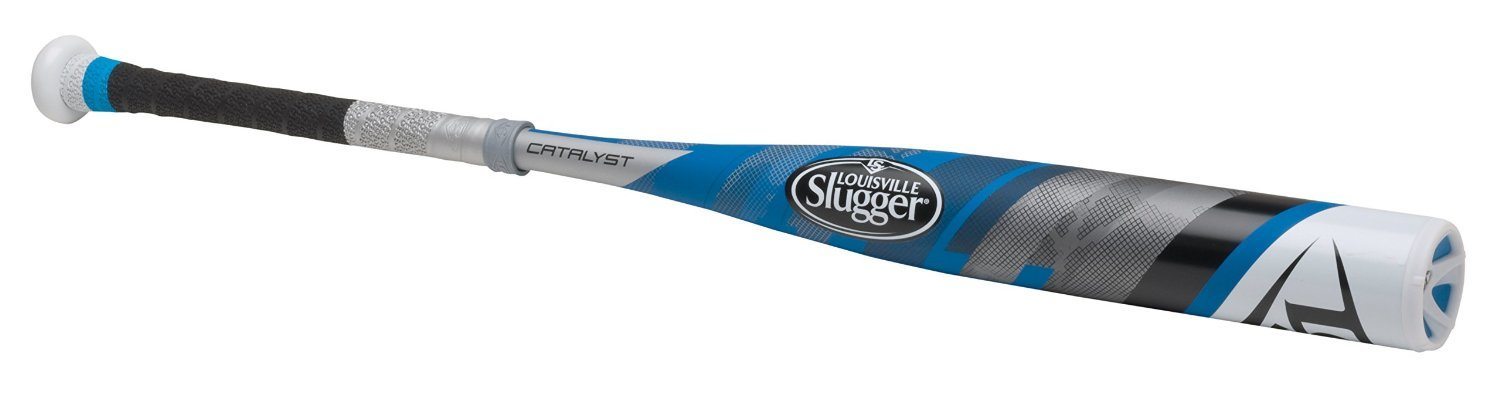
Material | Weight Drop | Barrel Diameter | Handle Diameter |
|---|---|---|---|
C1C Composite | -12 | 2 1/4 | 7/8" Tapered |
The 2015 Louisville Slugger Catalyst is a great starter bat for any kid who loves the game. This is a single piece, composite bat, so it is very durable and lightweight. This comes in at -12 drop weight.
What is drop weight, you ask?
It's pretty simple really, it's just a way of relating the weight of the bat to the length of the bat. -12 means that this bat weighs 12 ounces less than the length in inches. Okay that sounded more confusing than it should be.
For instance, if you were buying this bat at 30" in length, than the weight would be 18 oz. Because 30 - 12 = 18. Make sense?
Why You'll Love It
we were looking for a good "bang for the buck" bat for our son. He loves this one. I enjoy watching the ball come off as quickly as it does. I hit a couple with it just to play and liked the feel of it in swing.
justbats.com reviewer
This bat is designed to be swung with ease. The 2015 model features a newly tapered handle which, although really up to the player's preference, offers more comfort during the swing.
Not only that, but this bat feels quick. Because it is. Having a drop weight of -12 allows the player to maximize his bat speed and get the barrel through the zone faster. If you're kid is having trouble catching up with fastballs, this may be the option for you.
Let's talk a little bit about the composite material
Composite material offers a few advantages over traditional aluminum alloys (and also a few disadvantages as well). The most notable advantage to a composite bat, in my opinion, is the weight distribution. The more even the weight distribution, the lighter the bat will feel while swinging.
Composite materials, because of their durable nature, allow for a more even weight distribution throughout the bat, which means that it will feel light in your child's hands. This works wonders for their confidence.
Click here to check the latest prices for the 2015 model of the Catalyst.
RAWLINGS 5150 YOUTH
An aluminum bat that packs the punch your kid is looking for!
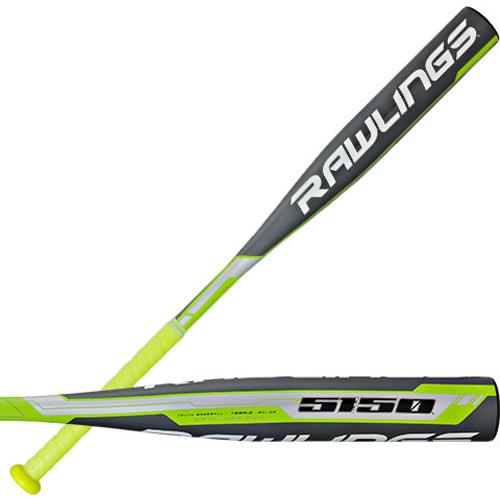
Material | Weight Drop | Barrel Diameter | Construction |
|---|---|---|---|
Aerospace Grade Aluminum | -13 | 2 1/4 | One Piece |
This bat right here is a beast! And for the money they are asking (check the price on Amazon here), it's almost robbery. Almost.
I went back and forth about whether I should rank this as the number one option or not. Ultimately, I went with number two because of the sting factor. Because this is a one piece bat made from an aluminum alloy, you'll feel more vibration from a ball hit off the handle or end.
However! Because this is a one piece aluminum bat (made from an aerospace grade alloy) it really packs a lot of punch. If your kid isn't afraid of a little hand sting now and then, you should get them this bat.
Great ping and feel. My son was using a Rawlings Velo and He loves the new 5150.
justbats.com reviewer
Trampoline Effect
One of the great elements of this bat is the engineering that's gone into the barrel design - specifically the weight distribution. Rawlings has emphasized the "trampoline effect" to give this bat the utmost pop.
From their website:
Shaped from the radically responsive, aerospace-grade Rawlings 5150® Alloy, this one-piece construction equips hitters with expanded balance, transcending speed and magnified power. Rawlings' Precision Optimized Performance (pOp™) barrel technology as seen in the 5150®, isolates excess weight to a smaller region of the bat amplifying trampoline and generating additional barrel flex. Chosen by countless championship teams, the Rawlings 5150® gives new meaning to the phrase "power in numbers".
EASTON S3 YOUTH ALUMINUM
A wonderful aluminum option from the most respected manufacturer in the game!
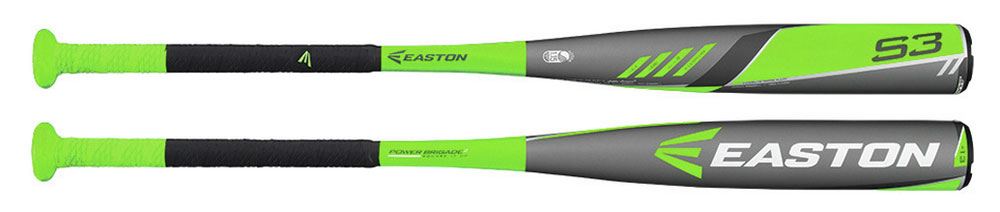
Material | Weight Drop | Barrel Diameter | Construction |
|---|---|---|---|
HMXATM Hyperlite Matrix Alloy (Aluminum) | -13 | 2 1/4 | One Piece |
Some kids just gotta have an Easton.
Full disclosure, the first bat that I ever owned was an Easton. It was a graphite composite bat, that in 1992 was way ahead of it's time.
And that's what Easton does best - engineer bats that are outside of the box, industry changing juggernauts.
Which is why it pains me to list this as the third best option. The Easton S3 is still a great option, don't get me wrong, but it's not quite at the same level as the previous two bats.
Why You'll Love it
Champions of this bat will point to the great pop that it provides. Much like the Rawlings 5150, this is a one piece, aluminum alloy bat. Which, as we know, means power and hand sting.
Contact, however, is what Easton touts the most about this bat. With an expanded sweet spot, and "Hyperskin" handle wrap, this bat is designed to provide great bat control with a forgiving barrel.
All of the characteristics that define the archetype of a "Contact Hitter" can be found in the new Easton S3 Youth Baseball Bat: YB16S313 - 1.) The S3 is forged from HMX (Hyperlite Matrix) Alloy for an expanded sweet spot and tremendous trampoline effect.
Why You May Not Love It
This is the only reason that this bat sits in third position.
There seem to be a lot of people leaving reviews of this bat that are not satisfied with it's durability. Specifically, people report that the bat can develop "flat spots" or dents. In Easton's defense, it's always tough to judge what a bat has gone through without owning it yourself.
For instance, these bats are not designed to be used in batting cages above certain speeds and over certain lengths of time. Have you ever seen a batting cage ball? They are way more dense than any baseball. They can destroy an aluminum bat quickly.
Also, these bats are designed for kids aged 7-10. There's a reason why these bats have a weight drop of -13, and it's that kids of this age don't generate as much bat speed and thus can handle a lighter bat without damaging it. The same is not true of an older brother or Dad hitting fly balls.
That's as far as my defense goes however, because at some point, where there's smoke, there's fire.
Check Amazon to learn more about the S3 and see for yourself if it's right for your child.
Did I miss a great option? Leave a comment and let me know!
Baseball Season is here! And that means it's time to be overly critical of every at bat, play in the field, and failed stolen base attempt. As part of a series of posts this summer, I'll be breaking down my own performance, and seeing what lessons I can take away from every game.
I play in a men's adult baseball league called the National Adult Baseball Association (NABA for short).
More...
Game 1 - Hitmen vs. Snappers (yes those are the names)
If you're anything like me, you're really hard on yourself - and that's okay. We get better by being hard on ourselves. It only becomes a problem if you don't view your shortcomings as opportunities to learn.
But you can't beat yourself up. With that said, watch me beat myself up...
Offensive Breakdown
AB | R | H | RBI | BB | SO | PA | BA | OBP | SLG | OPS |
|---|---|---|---|---|---|---|---|---|---|---|
4 | 1 | 2 | 1 | 0 | 2 | 4 | .500 | .500 | 1.000 | 1.500 |
Triple, Single, RBI and Run Scored.
This looks pretty good at first glance. And I'm happy with it, in general. But you will notice that I struck out twice during this game - once looking and once swinging. I really hate striking out - it's such a waste of an at bat. But it's going to happen.
When a strikeout is unacceptable
A strikeout is unacceptable when there are men on second and third with one out. That's an unacceptable strikeout.
In a situation like that you have one job: put the ball in play. Preferably in the air - the harder the better. It's a moment that many hitters relish because you basically have complete freedom to swing aggressively.
Let me set the scene for you...
It's the bottom of the sixth inning. I'm due up fourth, and the first two runners have reached base via walk. The pitcher is a little wild this inning, is what I'm thinking. There are no outs and the hitter in front of me is smart, and he plays a little small ball, laying down a bunt. It's successful and he advances the runners with the sacrifice.
Now we have runners on second and third with one out. Did I mention it's a tied game? They pull the infield in to cut off the go-ahead run.
Normally, I go up to the plate in this situation thinking "take a hack".
But because of the two walks I'm thinking, "I might not get anything good to hit, let's see if he can throw strikes."
The first pitch is absolutely mouth watering. It's up in zone, it's flat, and it's a mediocre fastball. And I take it for a called strike. LIKE AN IDIOT. That is exactly the type of pitch that I should have been gearing up for.
Now it's 0-1. No time to panic, I just need a good pitch to hit. So what's he throw me? A good curveball that I take for another strike. It was a good pitch, I'll admit that, but still one that I could have hit.
Okay, so now it's 0-2 and I haven't swung the bat. Now we're in bad territory.
Here's where things can go a little haywire when you're in your head too much at the plate. I've seen two pitches - probably the only two pitches that this guy has. What will he come with next?
I shouldn't even be making a guess, in this situation. Instead, I should be looking fastball and adjusting to anything offspeed, and I should be protecting the plate. That's what I should be doing.
But, no, I'm guessing instead - and I'm thinking he's going to waste a pitch to see if I'll chase. I'm specifically thinking that he's going to throw another curve down and off the plate. So that's where I'm cheating.
I have to give the pitcher credit. He played me like a fiddle and whatever wildness he had in the beginning of the inning was apparently gone. He comes back with a fastball right under my hands - inside, but still catching the plate. Because I was looking out over the plate for something offspeed, I can't adjust to fastball in...
I swing, but can't get the barrel to catch up. Strike three.

A wasted opportunity. Now there are two outs in the inning, the infield can move back, and we can't produce a run with an out. I don't even remember what the batter after me did, but he made an out. Inning over. Game still tied. The game ended in a tie, by the way.
What I learned, in the end...
There are still a lot of positives to take away from the game. For one, we only scored 3 runs in the game total - I was responsible for driving one of them in, and scoring another. That's good. That's what I will take with me as a positive into the next game.
Are you playing right now? What lessons have you learned along the way?
editor’s pick
latest video

news via inbox
Nulla turp dis cursus. Integer liberos euismod pretium faucibua
